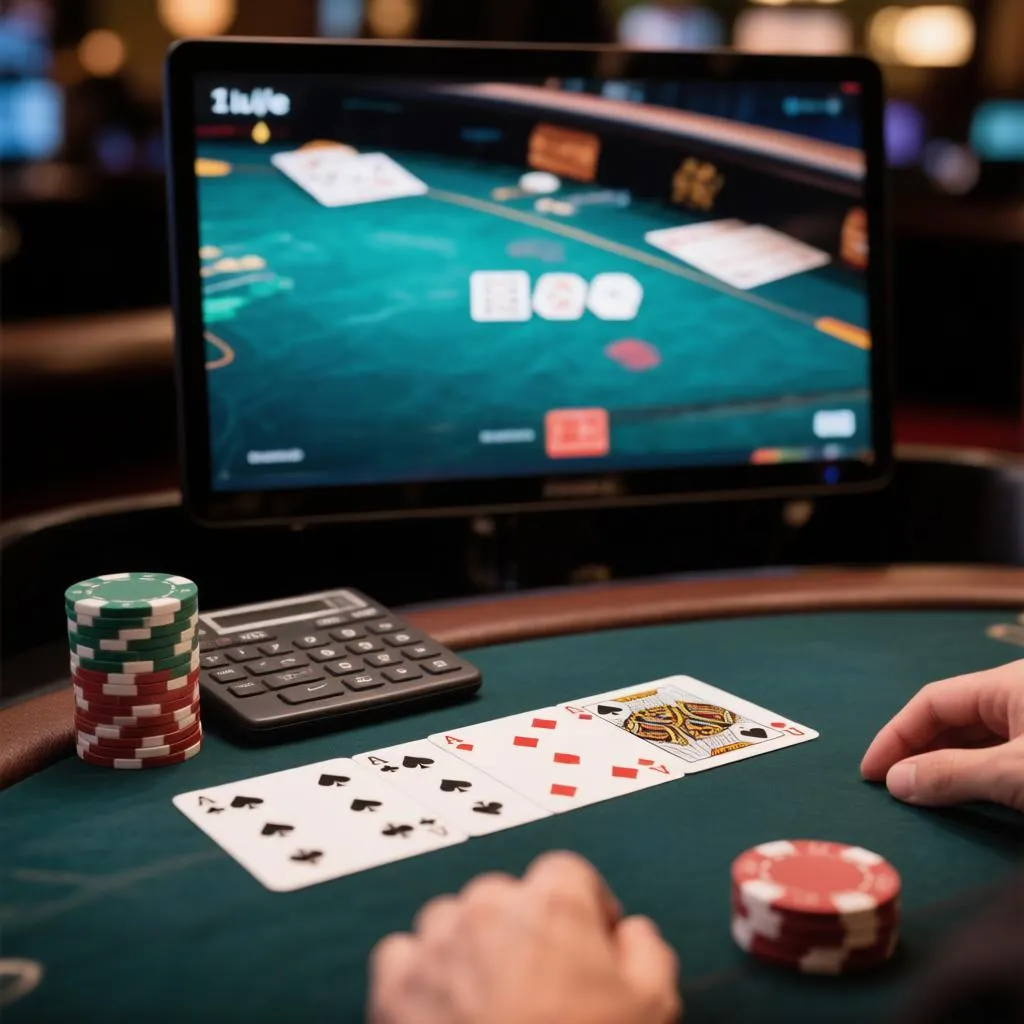
Card counting is the most celebrated technique in gambling history and the most misunderstood. Half the world believes it is a magic system that beats the casino on command; the other half believes it is impossible anywhere online. The truth sits between, and it hinges on one technical question that most players never think to ask: does the deck remember what happened?
That question has different answers in different corners of an online casino. The digital blackjack tables running on random number generators are engineered to erase the deck’s memory after every hand, while the live dealer tables with physical shoes may preserve it — depending on how often and where the shoe is cut and reshuffled. Walking through both environments in detail reveals where counting lives, where it dies, and why most promises made about it online are worth exactly nothing.
The principle: why memory is everything
Blackjack is unique among major casino games because dealt cards leave the game. Unlike roulette, where every spin is independent, blackjack’s probabilities shift as cards are exposed. If a shoe has spent its high cards, the remaining shoe is poorer in blackjacks and player-favorable doubles; if it is still rich in tens and aces, the remaining shoe is friendlier to the player than the house’s baseline edge suggests.
Counting exploits exactly this. Every counting system, from the simplest to the most exotic, condenses the visible history of the shoe into a single running number. When that number indicates a ten-rich shoe, the player’s advantage — normally negative — can flip positive, and the correct response is to bet more. When the number indicates the opposite, the correct response is to bet the table minimum. The technique never predicts individual cards; it prices the shoe.
The industry standard, Hi-Lo, works like this: cards 2 through 6 count +1, cards 7 through 9 count 0, and tens through aces count −1. A running tally of these values, divided by the estimated number of decks remaining to produce the “true count,” tells you whether the next stretch of the shoe leans toward you or the house. Roughly speaking, each unit of true count above zero shifts the edge about half a percent in the player’s favor, which is small per hand but decisive over thousands.
The RNG verdict: the count dies by design
Digital blackjack operates under a principle that removes the counting premise entirely. The standard implementation reshuffles a full virtual shoe before every hand — or, in some engines, draws each card from a freshly simulated deck. Either way, the deck starts over every round, and history carries no information.
This is not operator paranoia or hidden rigging; it is the natural engineering choice. Software makes continuous shuffling effortless and free, so there is no reason to preserve a shoe across hands. The practical consequences for would-be counters are total:
- No running count has any meaning, because each hand is dealt from a statistically fresh deck.
- Betting spreads — the core of counting profit — accomplish nothing, since every hand carries identical odds.
- Games advertising “continuous shuffling” or immediate reshuffles in their information screens are telling you this openly; the disclosure is right there, most players just never open the menu.
A minority of RNG games historically played a persistent shoe with a defined reshuffle point, and in those rare cases counting retains a theoretical residue. But even then, operators typically cut the shoe in half, so only a fraction of cards are ever exposed before the reset — stripping most of the edge that makes counting worthwhile. The honest summary: any software, course or app claiming to beat RNG blackjack through counting is selling a fantasy, and often selling it to the same audience twice.
Live dealer tables: the last viable habitat
Live blackjack is where the shoe is physically real, dealt by a human from a transparent holder on camera. Here the cards genuinely persist between hands, and a running count is meaningful again. This is why counting discussion online almost always gravitates to live tables rather than the RNG section.
Viability, however, depends on details the table itself decides. The critical variable is penetration — the percentage of the shoe dealt before reshuffling. Land-based casinos traditionally dealt deep into the shoe; online live studios are more protective, cutting at 50% to 65% of the shoe or, on some tables, reshuffling with an automatic shuffler after every round, which recreates the RNG problem in physical form. Shallow penetration starves the count: with half the shoe hidden, the information advantage shrinks dramatically, and the achievable edge with it.
The table selection checklist for anyone serious about trying looks like this:
- A visible shoe dealt down past 60% before the shuffle, ideally deeper.
- Blackjack paying 3-to-2, not 6-to-5 — the reduced payout can erase the counting edge entirely by itself.
- Standard rules otherwise: dealer standing on soft 17 if possible, doubling on any two cards, and resplits where available.
- Eight-deck shoes are workable; single- and double-deck live games are rare but far more fertile when found.
Tables meeting these criteria exist, but they are a shrinking share of the live lobby, and studios are aware of exactly which configurations counters seek out. The economics of the arms race favor the house: it is far cheaper for an operator to adjust shuffling procedure than for a player to find and exploit the rare generous table.
The legal truth and the practical defenses
One fact deserves stating without hedging: counting cards is legal. It uses no devices, no marked cards and no inside information — only publicly visible data processed mentally. No law in any major gambling jurisdiction prohibits it, and nothing in online terms of service criminalizes it either.
What operators have instead is the right to refuse service, and online they exercise it far more efficiently than any physical casino ever could. Every hand is logged, every bet size is timestamped, and pattern-recognition systems flag exactly the signature counting produces: a flat line of minimum bets punctuated by sudden, correlated raises in shoe depth. The response options are administrative rather than legal:
- Individual bet limits reduced to levels where counting no longer pays.
- Removal from bonus and loyalty eligibility, where the terms permit it.
- Account restriction or closure for persistent advantage play, at the operator’s discretion under its terms of service.
For a professional counter, being identified is not a scandal — it is a scheduled event. Successful teams budget for account turnover, maintain multiple venues and treat restrictions as an operating cost. For a recreational player curious about the technique, the realistic expectation is that a disciplined spread will eventually draw attention, and the count’s lifetime at any single venue is measured in weeks or months, not years.
What the edge actually delivers
The gap between the mythology and the arithmetic is where most enthusiasts get lost. With a well-executed Hi-Lo spread on a decent live shoe, the player’s average edge runs somewhere between 0.5% and 1% of total amount wagered — a genuine positive expectation, and one of the rarest things in gambling. But the translation into money is sobering.
Consider a committed counter betting an average of 25 units per hand across hands spread through a shoe, at maybe 100 hands per hour on a live table. At a full 1% edge — an optimistic figure — the expected profit is roughly 25 units per hour, against a variance that routinely produces losing days, weeks and months. The bankroll needed to survive that variance without ruin is conventionally sized at around 100 times the maximum bet, and the timeline for the edge to manifest reliably is hundreds of hours of flawless execution.
| Factor | Mythical version | Realistic version |
|---|---|---|
| Edge over the house | Guaranteed winning | 0.5%–1% average, when the shoe allows |
| Skill needed | Memorizing cards | Sustained Hi-Lo execution under pressure |
| Time to profit | First session | Hundreds of played hours |
| Bankroll | Any deposit | Roughly 100x max bet, risked knowingly |
| Main risk | Getting banned | Variance, fatigue and account limits |
This table is the antidote to every “counting changed my life” thumbnail online. The technique is real; its payoff is modest, slow and conditional on conditions that are increasingly scarce online. Most people who learn it properly conclude that the discipline it builds — rule awareness, variance literacy, emotional control — ends up being worth more than the counts themselves.
How to practice it properly, if you insist
For players who want to attempt the real thing on live tables, the training path is short on secrets and long on repetition. The sequence that actually works is this:
- Master basic strategy completely first, because the count rides on top of it and a shaky foundation poisons everything.
- Drill Hi-Lo at home with a physical deck, timing a full pass through 52 cards; under 30 seconds without errors is the entry benchmark.
- Add deck estimation and true-count conversion, then practice bet spreading on paper before risking money.
- Play live tables at minimum stakes for weeks with the sole goal of sustaining the count under real game speed and distractions.
- Track everything — hours, counts, results — and evaluate progress across hundreds of hands, never single sessions.
Step 4 is where enthusiasm usually dies, and that is fine. Discovering that the execution is boring, the edge is slow and the surveillance is patient is a cheap lesson when learned at minimum stakes and an expensive one learned any other way.
The verdict
Does card counting work online? With RNG blackjack, no — structurally, permanently, by design. With live shoes, yes — conditionally, modestly and under growing pressure from penetration rules and pattern detection. The technique is legal, the math is sound and the lifestyle it implies is far less glamorous than its reputation.
For the overwhelming majority of players, the practical takeaway is smaller and more useful than the dream: learn basic strategy, read table rules before sitting down, understand what reshuffling does to the odds, and be deaf to anyone selling predictions, signals or “counting software.” The real edge in online blackjack was never the count. It was knowing exactly which tables deserved your money and which ones were playing a different game than the one you thought you chose.