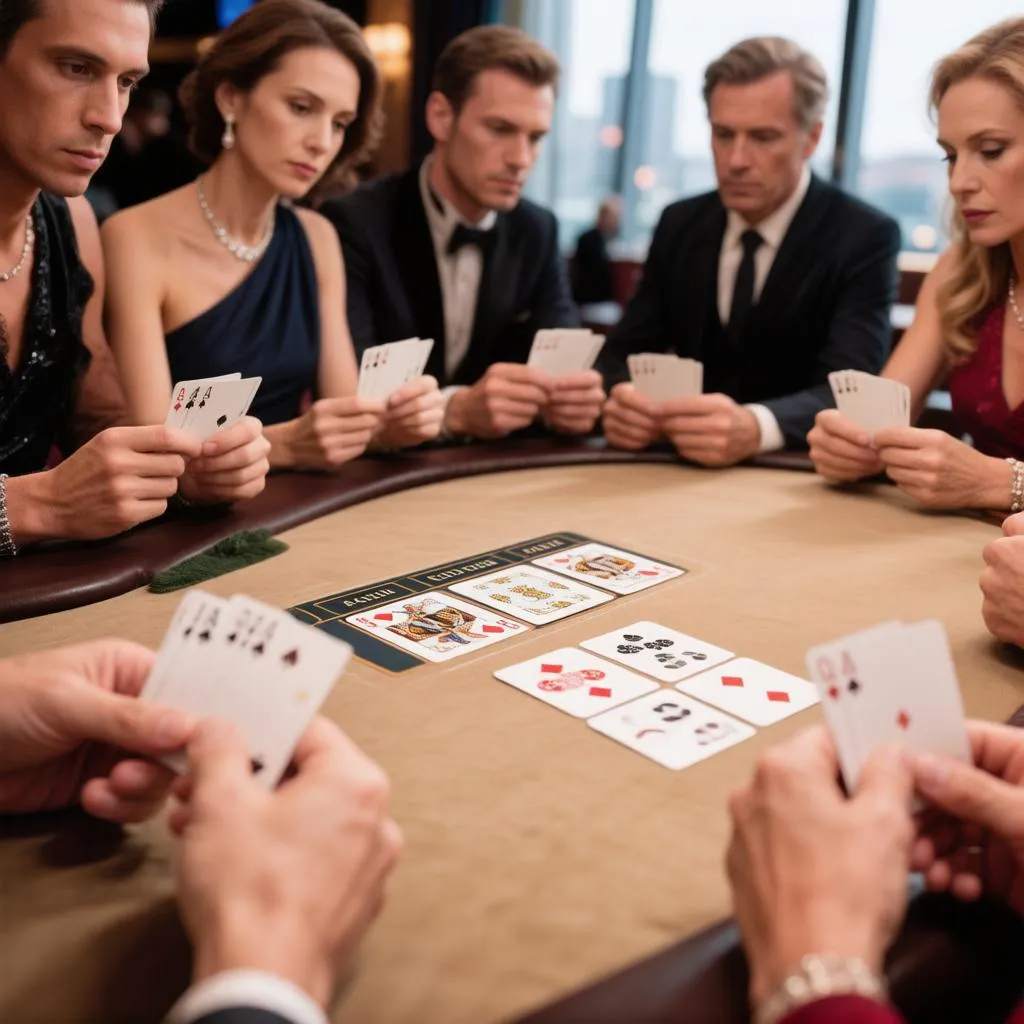
The poker boom left something behind besides memories: a permanent category of table games that borrow poker’s language without poker’s opponents. Casino Hold’em and Pai Gow are its two most durable representatives, and they occupy opposite ends of the same idea. Casino Hold’em takes the most popular poker variant in the world, removes the bluffing and the other players, and reduces the entire game to one question per hand — does my two-card pair beat the dealer’s five? Pai Gow takes a Chinese domino game, grafts seven-card poker onto it, and turns every hand into a two-front battle: five cards against five cards, two cards against two cards, both must win or the house collects. Neither game involves reading an opponent, because there is no opponent — the dealer plays a fixed script, and the entire skill ceiling lives in the decisions the script leaves to you. That ceiling is low compared to real poker, but it is not zero: playing Casino Hold’em with correct fold discipline costs the house roughly a quarter of a percent of its edge, and setting hands properly in Pai Gow converts a struggling player into a competent one faster than any strategy card in blackjack. This guide walks through both games from the felt up: the rules, the optimal decisions, the side bets, the commission structures, and the honest comparison of which game rewards which kind of player.
Casino Hold’em: Texas Hold’em against the house
Casino Hold’em preserves the community-card skeleton of its namesake. The player posts an ante, receives two hole cards, and the dealer takes two of its own; three community cards flop immediately, and the player’s first decision arrives: fold, surrendering the ante, or call by posting a raise — typically twice the ante — to see the turn, river and showdown. After five community cards are complete, both hands make their best five-card poker hand, and the higher hand wins. The dealer qualifies with a pair of fours or better; an unqualified dealer hand pays the ante at 1-to-1 odds while pushing the raise, and a qualified dealer loss pays both ante and raise.
The raise-versus-fold decision is where the entire game’s strategy lives, and the mathematics is more forgiving than the decision feels. The optimal strategy can be compressed into a single dominant principle with a few refinements:
- Call with any pair of fours or better, always. This baseline alone captures most of the strategy’s value, and the temptation to fold weak pairs against scary boards is where most of the average player’s edge leaks out.
- Call with four cards to a flush or an open-ended straight draw on the flop, even with no pair — the draw’s equity against the dealer’s random holding clears the raise’s cost.
- Call with two overcards to the board in the common marginal zone — king-queen, queen-jack, king-jack configurations — where the draw outsides plus overcard equity justify the two-unit raise.
- Fold everything else. Low unpaired holdings with no draw are the fold zone, and folding correctly costs exactly one ante per instance while calling incorrectly costs three.
Played with this discipline, Casino Hold’em’s house edge sits at roughly 2.1% of the ante — or around 0.5–0.6% expressed as a percentage of total money wagered, which is the honest comparison figure against other table games. Playing without discipline — calling every hand out of curiosity — roughly triples the edge, which is why the fold button is the most valuable control in the game.
The optional Ace-up or Ante Bonus side bet deserves its own verdict. It pays bonus amounts on the player’s hole cards paired with the flop — trips, straights, flushes and above — with published house edges typically running from 6% to well above 10% depending on the paytable. As with every side bet in the card-game canon, the ladder of payouts prices a low-probability event at a steep discount, and the main game’s 2.1% edge is the number the bet should be measured against before any unit touches the bonus circle.
Pai Gow: the two-front chess of poker
Pai Gow poker is the most strategically distinctive game on the casino floor, and its rules need careful stating because the structure has no equivalent elsewhere. Every player and the dealer receive seven cards from a 53-card deck — the standard 52 plus one joker, which plays as an ace or completes straights, flushes and straight flushes. Each player arranges the seven cards into two hands: a five-card “back” hand and a two-card “front” hand, with one inviolable constraint — the back hand must outrank the front hand. Misplaced cards lose automatically. The player’s two hands then face the dealer’s two hands, and the outcome works like this: win both hands and the bet is paid minus commission; split the hands and the bet pushes; lose both and the bet is lost.
The five-card hands rank by standard poker rules; the two-card front hand can be only a pair or a high card, which makes the front-hand decisions the game’s recurring puzzle. The joker’s flexible role — full wild in five-card configurations only in the straight-flush sense, otherwise an ace — adds one more layer most newcomers misplay.
The commission structure defines the game’s economics. Standard Pai Gow charges a 5% commission on net wins, and the house edge against a correctly played hand sits around 2.7%. The popular commission-free or reduced-commission variants change the balance: versions where the dealer’s specific seven-card hand — typically a “pai gow” of jacks or better or a certain five-trip structure — pushes against the player reduce the edge below 2%, and reading which variant a table runs is the first piece of table selection any Pai Gow player should perform.
The side-by-side comparison
Both games sit at live tables and live-dealer studios with modest edges, but their textures differ more than their prices suggest, and the comparison consolidates the differences into the profile a player actually chooses between.
| Parameter | Casino Hold’em | Pai Gow |
|---|---|---|
| House edge (well-played) | ~2.1% of ante (~0.5–0.6% of total action) | ~2.7% at 5% commission; below 2% on push variants |
| Core decision | One per hand: call or fold | One per hand: set the two-card and five-card split |
| Hand frequency | Moderate | Slow — many pushes, 40%+ of hands |
| Skill ceiling | Low but real — fold discipline | Moderate — hand-setting rules matter |
| Session pace | Brisk | The slowest popular table game |
| Variance | Moderate | Very low — pushes dominate |
| Side bet | Ante Bonus, typically 6–10%+ edge | None standard; variants vary |
| Best-fit player | Hold’em fans wanting decisions | Patient players wanting long sessions |
The table’s push statistic deserves expansion because it is Pai Gow’s defining feature: roughly four in ten hands end in a split, the bet neither wins nor loses, and the bankroll drains at the slowest rate of any table game in the house. For a player whose goal is maximum session length per unit budgeted, Pai Gow is structurally unbeatable; for a player whose goal is decisions per hour, Casino Hold’em delivers more choice per minute than almost any game short of a poker room.
Setting hands in Pai Gow: the rules that matter
Hand-setting is Pai Gow’s entire skill content, and the good news is that a compact set of principles covers the overwhelming majority of real-world hands. The casinos publish their own dealer-setting scripts — the “house way” — and a player who learns its logic competes with the dealer on equal footing. The core rules, in order of importance:
- Never set a front pair when the back needs it more. The cardinal error is splitting a strong pair to make a weak front hand while gutting the back; the standard rule is to keep pairs of kings or better together in the back unless a second strong pair exists to anchor the front.
- Two pairs split by strength. A pair of aces plus a low pair splits — the aces anchor the back, the low pair goes to the front. Two high pairs usually stay together in the back with the two highest single cards in front; two low pairs often split with the better pair in back.
- Trips divide when the remainder allows. Three of a kind splits whenever the leftover cards can form a playable front — except trips of aces or kings, which usually stay together in back.
- Straights, flushes and full houses go whole into the back in nearly every configuration, with the two highest remaining cards forming the front. The exceptions are rare and mostly involve jokers.
- The joker is an ace or a filler. It completes a straight or flush in the back whenever possible, otherwise it plays as an ace — and its most common misuse is treating it as a full wild, which it is not.
- When in doubt, mimic the house way. Every table’s posted rules are available, and the dealer’s own script is a public, legal cheat sheet — the only game in the casino where the house shows its strategy before the hand is played.
A player who internalizes these six rules plays within a fraction of a percent of optimal setting, which is the entire reachable skill level in Pai Gow — and it is a level most table players reach in an afternoon, making Pai Gow the cheapest education of any poker-adjacent game in the house.
The mistakes that cost the most
Each game has a characteristic error that outcosts all the others combined, and naming them is worth more than any additional strategy detail:
- In Casino Hold’em: calling instead of folding. The two-unit raise turns curiosity into a 3% edge on every misplay, and the marginal zone — low pairs on paired boards, weak unpaired holdings — is where the average player’s session quietly drains. Folding weak hands is not timidity; it is the game’s optimal play at least a third of the time.
- In Casino Hold’em: ignoring qualification. Players forget that an unqualified dealer hand — below a pair of fours — pays the ante even when the player’s own hand is weak, which changes the arithmetic of marginal calls and explains why some “bad” calls are actually correct.
- In Pai Gow: splitting aces into two aces. A pair of aces in the front is strong, but splitting them to create two front aces leaves the back hand destroyed; the standard play keeps the pair intact and the front modest.
- In Pai Gow: setting the five-card hand first out of habit. The front hand’s two cards are the game’s constraint engine, and experienced setters decide the front’s needs before committing the back — a sequencing habit that prevents the automatic-loss mis-sets where the front outranks the back.
The honest verdict on both games
Casino Hold’em and Pai Gow solve different problems for different players, and the choice between them is a temperament question the math can clarify but not settle. Casino Hold’em is the game for the Texas Hold’em graduate who misses making decisions: the call-fold structure preserves poker’s most transferable skill, the edge is modest when discipline holds, and the side bet is the only trap worth declining. Pai Gow is the game for the player who measures a session in hours rather than hands: the push frequency turns every unit into the longest ride on the floor, the house way turns setting into a learnable system, and the 5% commission is the fair price of a game that offers back nearly everything it takes through sheer pace.
Both games share the trait that made them survivors of the poker boom: they borrow poker’s vocabulary to offer games with fixed, scriptable dealer play — all of the familiarity, none of the variance that comes from a skilled opponent. A player who knows this enters each game with the right expectations: the ceiling is low, the floor is honest, and the decisions that exist are worth making correctly — because in the two poker-style games that outlasted the boom, the difference between the average player and the competent one is not a secret system but a handful of folds and a handful of splits, applied with the patience the games were designed to reward.