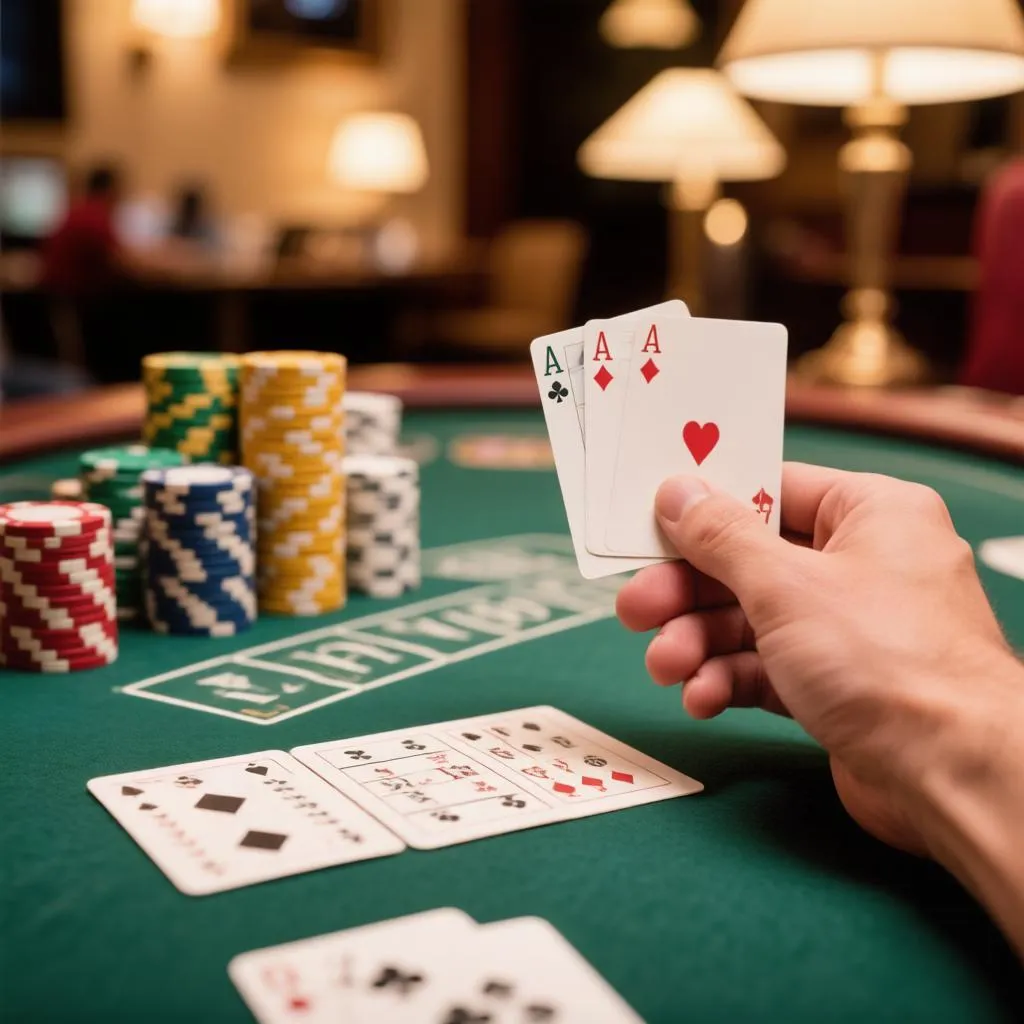
The dealer burns a card, deals the flop, and eleven people lean in at once — and the strange thing about poker is that only one of them is actually playing. The rest are reacting. This is the game’s oldest secret and the reason it rewards beginners faster than almost any other card game: the rules take an evening to learn, but the difference between reacting and playing is a single habit, and it is learnable on day one. Poker is not one game but a family of games sharing a common core — five-card hands ranked in a fixed hierarchy, betting rounds that let you fold, call, raise or check, and a showdown where the best hand takes the pot. Within that family, Texas Hold’em is the lingua franca: the variant played in every casino, every televised final table and every home game from Moscow to Melbourne, and the variant this guide uses as its spine. What follows covers the complete foundation — the hand rankings, the flow of a hand from blinds to showdown, the betting options, the position concept that separates disciplined players from generous ones, and the single mistake that accounts for more beginner losses than every other error combined.
The hand rankings: the hierarchy everything else hangs on
Every decision in poker ultimately reduces to one question — how strong is my five-card hand, and how strong can my opponent’s be? The ranking system answers the first half, and it is identical across virtually all poker variants. The full hierarchy, from strongest to weakest:
| Rank | Hand | Definition | Example |
|---|---|---|---|
| 1 | Royal flush | A, K, Q, J, 10, all the same suit | A♠ K♠ Q♠ J♠ 10♠ |
| 2 | Straight flush | Five sequential cards of one suit | 9♥ 8♥ 7♥ 6♥ 5♥ |
| 3 | Four of a kind | Four cards of the same rank | Q♣ Q♦ Q♥ Q♠ 4♣ |
| 4 | Full house | Three of a kind plus a pair | J♦ J♣ J♠ 9♥ 9♠ |
| 5 | Flush | Five cards of the same suit, non-sequential | K♦ 10♦ 8♦ 6♦ 3♦ |
| 6 | Straight | Five sequential cards of mixed suits | 8♠ 7♦ 6♣ 5♥ 4♠ |
| 7 | Three of a kind | Three cards of the same rank | 7♣ 7♦ 7♠ K♦ 2♥ |
| 8 | Two pair | Two separate pairs | A♥ A♠ J♣ J♦ 5♠ |
| 9 | One pair | Two cards of the same rank | 10♦ 10♣ A♠ 7♥ 3♣ |
| 10 | High card | None of the above; highest card plays | A♣ J♦ 9♠ 6♣ 2♦ |
Three details of this hierarchy resolve most real-table disputes. Ties break by the top cards first: the higher pair wins between two one-pair hands, and identical ranked hands split the pot regardless of suits. The ace plays both ends — it completes the highest straight (ace through ten) and the lowest (ace through five, the “wheel”). And in Texas Hold’em, a player may use any combination of their two hole cards and the five community cards — including playing the board itself when the five community cards form the best hand available to everyone.
How a hand unfolds: from blinds to showdown
A Texas Hold’em hand follows a fixed sequence, and the sequence is the entire game’s skeleton. Before any cards appear, two players post forced bets: the player immediately left of the dealer button posts the small blind, the next player posts the big blind, and these forced bets guarantee every hand has money worth contesting. The dealing and betting then proceed in four streets, each separated by community cards revealed face up in the middle of the table:
- Pre-flop. Each player receives two private hole cards. Betting opens with the player left of the big blind, and each participant may fold, call the current bet or raise. The round ends when all active players have matched the highest bet.
- The flop. Three community cards are dealt face up. Betting begins with the first active player left of the button, and the checking option appears: a player may pass the action without folding, provided no bet has yet been made in the street.
- The turn. A fourth community card is revealed, followed by a betting round on the same rules.
- The river. The fifth and final community card appears, the last betting round plays out, and if more than one player remains, the showdown follows: players reveal their hands, and the best five-card combination wins the pot.
At the showdown, the last aggressive player shows first, and the rule that surprises every newcomer is that showing is optional for losing hands — a player may muck face down when beaten, and the etiquette of waiting to be shown the winning hand before folding is universal. Between streets, the betting actions available are the game’s real vocabulary, and each means something precise: fold surrenders the hand and any money already invested; check passes without betting, available only when no bet faces you; call matches the current bet; bet opens the action in a round where no one has wagered; and raise increases the current bet, forcing everyone else to re-decide.
The engine underneath: odds, outs and pot odds
Beneath the hand rankings sits the arithmetic that turns poker from a guessing game into a decision game, and its entry point is the concept of outs — the unseen cards that would improve your hand. Holding four cards to a flush after the flop, nine cards of your suit remain in the deck, and the shortcut every player learns is the rule of two and four: multiply your outs by four to estimate the chance of completing the hand by the river (roughly 36% for nine outs), or by two for the chance on the next card alone (roughly 18%).
Pot odds convert that percentage into a decision. If the pot contains 100 and a bet of 25 faces you, calling costs 25 to win 125 — odds of 5 to 1, meaning the call needs only about 16.7% equity to break even. Comparing your outs-percentage to your pot-odds-percentage is the whole framework: when the first exceeds the second, the call is profitable in the long run; when it does not, folding is the play that makes money. No instinct, no read and no “feeling about the hand” overrides this comparison — the players who survive at tables are the ones who fold hands they suspect are best when the price is wrong, and call hands they fear when the price is right.
The mistake every beginner makes
Now to the error promised in the title, and it is not a subtle one: beginners play too many hands. The average newcomer contests roughly two-thirds of their starting hands, calling raises with weak aces, middle connectors and any two face cards, on the theory that folding wastes an opportunity. The theory is exactly backwards. Poker is a game of selective aggression played over many hands, and the discipline of folding the majority of your holdings pre-flop — top professionals fold 70 to 80 percent of hands in full-ring games — is not caution but the source of all profit. Every weak hand you play enters a pot against players holding better cards, on average, and the small edges reverse into small losses that compound across a session.
The symptom list is short and diagnostic, and recognizing yourself in it is the fastest upgrade available at zero cost:
- Calling raises with ace-rag. Ace-six offsuit feels like a hand because of the ace, but against a raise it is dominated by ace-king, ace-queen and every pocket pair — the definition of a hand that wins small pots and loses big ones.
- Limping into pots. Merely calling the big blind pre-flop with mediocre hands builds pots with no fold equity, letting the stronger hands behind you raise freely while you play out of position with a capped holding.
- Chasing draws without the right price. Calling a large bet on the turn with eight outs and pot odds of 3 to 1 violates the framework above, and doing it repeatedly is the arithmetic definition of a losing habit.
- Staying in hands out of curiosity. The phrase “I wanted to see what you had” describes money spent on information that the fold button provides for free — the most common sentence at beginner tables and the most expensive one.
- Playing every session the same way regardless of position. The two seats after the button see more flops profitably than the two before the blinds ever can; the beginner plays identical hand ranges from all six positions and donates the difference.
Each symptom shares one root: the belief that playing more hands means playing more poker. The opposite is true. Folding is not the absence of play but its most profitable form — the action taken when the mathematics of the situation says your equity does not cover the price, and taking it quickly, without regret, is what every experienced player does dozens of times per hour.
Position and the discipline it teaches
If hand selection is the first lever, position is the second, and the two work together. Acting last in a betting round means deciding with complete information about everyone else’s intentions; acting first means deciding blind. This asymmetry is why the dealer button is the best seat at the table and why the same hand — say, king-ten offsuit — is a raise from the button and a fold from under the gun. Beginners who internalize one sentence about position have absorbed a third of the game’s practical wisdom: your position changes the value of your cards, and the cards do not change the position.
The discipline this produces generalizes beyond position. A player who folds ace-six under the gun, folds it again on the cutoff and finally raises it on the button has learned the meta-lesson that poker decisions are situational rather than absolute — that the same 1326 possible starting hands carry different values depending on where you sit, what has happened before you and what price you are being asked to pay. This is the mindset shift that separates players from reactors, and it is available on the very first session to anyone willing to fold hands they find pretty.
Etiquette, bankroll and the practical starting kit
The final layer of a beginner’s foundation costs nothing and pays immediately, because poker is a social game whose unwritten rules are enforced at every table. The essentials worth knowing before the first hand:
- Act in turn, always. Acting out of turn — betting before the action reaches you — reveals information, disrupts the hand and draws genuine ire; wait for your turn even when the decision is obvious.
- Protect your cards and state your actions clearly. A chip or hand on the cards prevents accidents, and a spoken “call” or “raise to 300” prevents the disputes that ambiguity invites.
- Never discuss or reveal a folded hand while others are playing. The information belongs to the active players alone, and the habit of “being honest” about what you folded is the fastest way to become unwelcome.
- Size the bankroll to the game, not the game to the bankroll. A cash-game bankroll of at least twenty to thirty buy-ins and a tournament bankroll of fifty or more absorbs the variance that even good play produces, and playing above that cushion converts normal swings intotilt.
- Set a session stop before the session. A pre-committed loss limit and time limit are the same discipline that governs every form of gaming, and poker adds a unique reason: tired, tilted decisions cost more than any run of bad cards.
None of these rules change the mathematics; all of them change the environment in which the mathematics plays out, and between them they prevent the practical failures — tilt, disputes, distraction — that end more beginner careers than any strategic gap.
Conclusion
Poker’s learning curve is famously front-loaded: the hand rankings take an hour, the flow of a hand takes an evening, and the pot-odds framework takes a week of practice — after which the game stops being a card game and becomes a decision game played with cards. The hierarchy from royal flush to high card is fixed and learnable; the four streets and their betting options are the game’s grammar; and the arithmetic of outs and pot prices is the grammar’s logic.
But the transformation that actually changes results is smaller and stranger than all of that: it is the decision to fold most of your hands. Playing too many holdings is the beginner’s universal signature — visible in every limped pot, every ace-rag call and every curiosity showdown — and its correction is the single highest-value lesson in the game, available before any other skill is learned. Learn the rankings, learn the streets, learn the price of a call, and then practice the hardest easy thing in poker: throwing away most of your cards without watching how the story ends. The players who do this are the ones still sitting at the table a year later — and the ones who do not have already paid for the lesson, one pretty hand at a time.