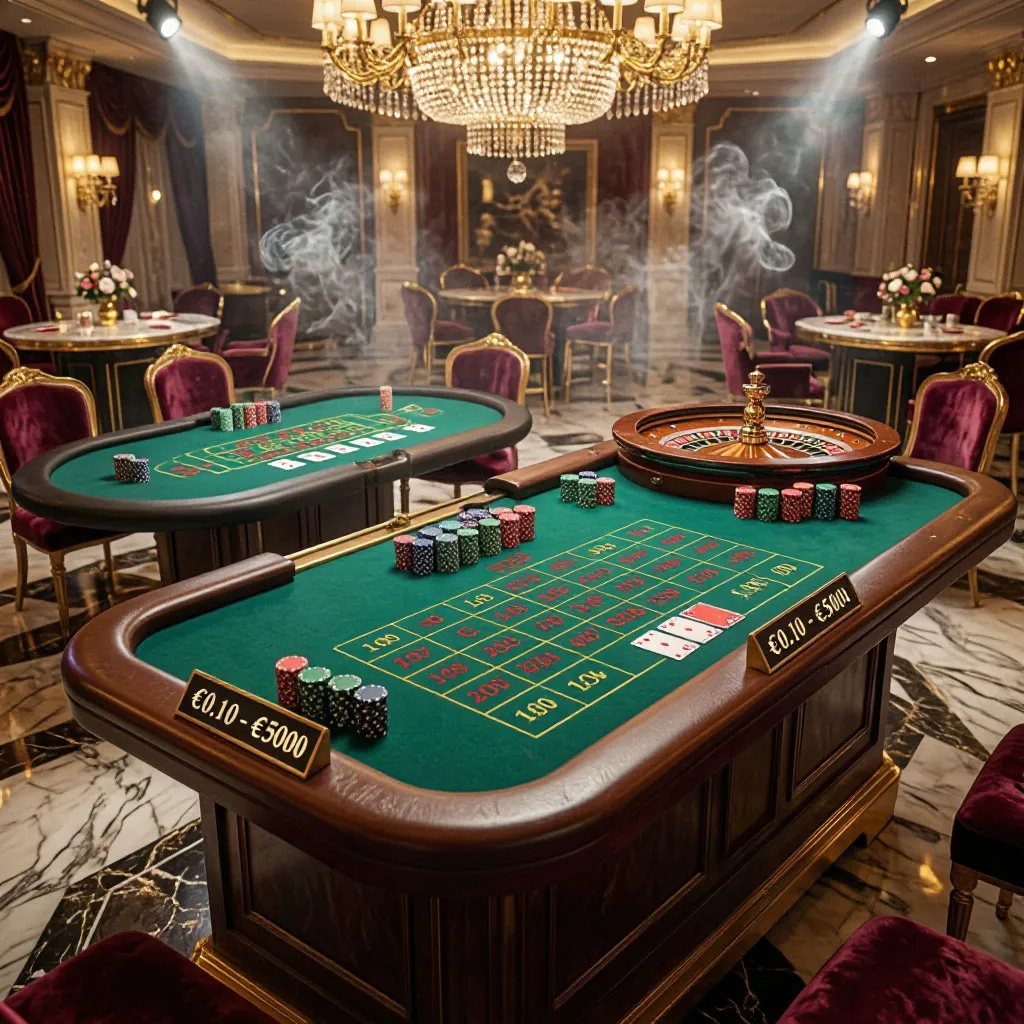
The green felt stretches across your screen, a real dealer shuffles real cards in a real studio, and before you place a single chip, a number flashes at the corner of the interface: Min €0.10 — Max €500. That pair of numbers is the single most important piece of information on the screen, yet most players glance past it without a second thought. Table limits define the boundaries of what you can and cannot do at a live casino table. They determine whether a casual player with twenty euros can enjoy an evening of play or bust out in three spins, and whether a high roller with a five-figure bankroll can place the bets they want or find themselves capped at an inconvenient ceiling. Understanding how these limits work, why they vary between games and providers, and how to match them to your bankroll is the difference between a planned, enjoyable session and a frustrating exercise in watching your chips disappear before the dealer even hits a hot streak.
How live casino table limits actually work
Every live casino table operates within two boundaries: a minimum bet and a maximum bet. The minimum is the smallest amount you can wager on a single betting round. The maximum is the largest amount the table will accept on any single bet or combination of bets in one round. These limits are set by the game provider — Evolution, Pragmatic Play Live, Playtech, Authentic Gaming — and are sometimes further adjusted by the casino operator hosting the table.
The minimum bet serves a practical purpose for the provider: each live table is expensive to run. A dealer, a studio, camera operators, lighting, streaming infrastructure, and compliance monitoring all cost money per hour. A table with a €0.10 minimum generates very little revenue per spin, so providers reserve these low-limit tables for specific purposes — attracting new players, filling seats during off-peak hours, or serving as entry-level tables that funnel players toward higher-stakes versions of the same game.
The maximum bet serves a risk management function. No casino, no matter how well-capitalized, wants unlimited exposure on a single spin. A player betting €50,000 on black in roulette and winning costs the casino €50,000 in a single round. Table limits cap this exposure, ensuring that the casino’s mathematical edge — which guarantees profit over time — is not disrupted by short-term variance. The maximum also protects the provider from the rare but real scenario of a player on a hot streak pressing their bets to a level that threatens the table’s operating budget.
Beyond the main bet limits, many live casino games have additional limits on side bets and combination bets. In blackjack, the insurance bet, perfect pairs side bet, and 21+3 side bet each carry their own minimum and maximum, which may differ from the main bet limits. In roulette, the maximum is often split between inside bets (straight-up numbers) and outside bets (red/black, odd/even, dozens), with inside bet maximums typically being much lower to prevent high-payout wins from exceeding the table’s risk threshold.
The bankroll-to-limits relationship: why matching matters
Your bankroll is the total amount of money you have set aside for a session of play. The table limits determine how many rounds that bankroll can sustain and how much variance you can absorb. A bankroll of €50 at a table with a €5 minimum gives you ten rounds of play at minimum bet — not enough to weather a losing streak or to give the variance a chance to turn in your favour. The same €50 bankroll at a €0.10 minimum table gives you 500 rounds, which is enough to experience the full range of outcomes that the game’s probability distribution can produce.
The relationship between bankroll and table limits is not about winning more — it is about surviving long enough for the game’s natural variance to play out. Every casino game has a house edge, meaning that over a very large number of rounds, you will lose money. But in the short term — a session of 50 to 500 rounds — variance dominates, and a player who has enough rounds to let variance work in their favour has a genuine chance of ending the session in profit. A player who runs out of rounds after ten or fifteen spins never gets that chance.
The conventional bankroll management advice is to have at least 50 to 100 times the minimum bet in your bankroll for a session. For a €1 minimum table, that means €50 to €100. For a €0.10 table, €5 to €10 is theoretically enough, though a slightly larger buffer is always wise. For high-limit tables with €50 or €100 minimums, the bankroll requirement scales to €2,500 or €5,000, which puts these tables firmly in the territory of serious players with dedicated gambling budgets.
Comparing limits across live casino game types
Not all live casino games are structured the same way, and their betting limits reflect the differences in their mathematics, pace, and risk profile. Roulette, blackjack, baccarat, and game shows each have distinct limit ranges, and understanding why these ranges differ helps you choose the right game for your bankroll.
To see how the four major live casino game categories compare in terms of betting limits, the following overview highlights the typical ranges you can expect to find across major providers.
| Game type | Typical minimum bet | Typical maximum bet | Side bet limits | Speed (rounds/hour) | Bankroll needed for 100 rounds at minimum |
|---|---|---|---|---|---|
| Live roulette | €0.10–€1 | €500–€10,000 | €1–€500 (inside bets capped lower) | 40–50 | €10–€100 |
| Live blackjack | €0.50–€5 | €1,000–€5,000 | €0.50–€500 | 60–80 | €50–€500 |
| Live baccarat | €0.10–€1 | €2,000–€10,000 | €1–€500 | 60–80 | €10–€100 |
| Game shows | €0.10–€0.50 | €500–€2,500 | N/A | 30–40 | €10–€50 |
Roulette has the widest range of minimum bets because it is the most popular live casino game and providers run dedicated low-stakes tables alongside high-limit versions. The maximum on inside bets is typically a fraction of the outside bet maximum, because a straight-up number hit pays 35:1 and a large inside bet could produce a payout that exceeds the table’s risk appetite. Blackjack limits tend to start higher than roulette because each seat represents a greater operational cost — a blackjack table serves a maximum of seven players, while a roulette table can serve an unlimited number of players betting simultaneously. Baccarat sits between the two, with high maximums that cater to the game’s traditional high-roller audience. Game shows have the lowest maximums because their bonus rounds can produce multipliers that make large base bets extremely expensive for the provider.
Finding tables for small bankrolls: the €0.10 to €5 range
Players with bankrolls under €50 are not excluded from live casino play, but they need to be selective about which tables they join. The good news is that the live casino industry has invested heavily in low-stakes tables over the past few years, recognizing that the casual player segment represents a significant and growing portion of the market.
Low-limit live casino tables are widely available across the major providers if you know where to look.
- Roulette tables with €0.10 minimums — Evolution runs dedicated low-stakes roulette tables, sometimes branded as “Low Roller” or “Auto Roulette” (where the wheel is automated but real, without a live dealer). Auto Roulette tables typically have the lowest minimums because they eliminate the dealer cost.
- Blackjack tables with €0.50 minimums — Bet Behind features allow you to bet on another player’s hand, with minimums as low as €0.50. Infinite Blackjack and Free Bet Blackjack tables, which accommodate unlimited players through a shared initial hand, also offer low entry points.
- Baccarat tables with €0.10 minimums — Speed Baccarat and No Commission Baccarat tables sometimes run at €0.10 minimums during off-peak hours. The “squeeze” variants, which are slower and more theatrical, tend to have higher minimums.
- Game shows with €0.10 minimums — Crazy Time, Monopoly Live, and Dream Catcher all offer €0.10 minimum bets on their base segments, making them accessible to the smallest bankrolls. The bonus rounds in these games can multiply a €0.10 bet into significant returns, though the probability of large multipliers is low.
The key for small-bankroll players is to avoid tables where the minimum exceeds 2% of the total bankroll. With €20, a €1 minimum table gives 20 rounds at minimum bet, which is marginal. A €0.10 table gives 200 rounds, which is comfortable. With €50, a €1 table becomes workable with 50 rounds, but a €0.50 or €0.10 table provides a much safer buffer.
Finding tables for mid-range bankrolls: the €5 to €500 range
The mid-range is where most live casino players operate, and it is also where the widest selection of tables is available. A bankroll between €100 and €1,000 opens up virtually every standard live casino table, with the exception of dedicated VIP and high-roller rooms. The challenge in this range is not finding a table — it is choosing the right one.
Players in this bracket should consider several factors when selecting a table beyond just the minimum and maximum limits.
- The speed of the game — faster games burn through bankroll more quickly. A Speed Baccarat table dealing 80 hands per hour consumes twice as much bankroll per hour as a standard baccarat table dealing 40. If your bankroll is €200 and you want a two-hour session, a slow game at a €1 minimum is a better fit than a fast game at the same minimum.
- The house edge of the specific bet — within each game, different bets carry different house edges. In baccarat, the banker bet has a 1.06% edge, the player bet 1.24%, and the tie bet 14.36%. Choosing the lowest-edge bet extends bankroll longevity even at the same table limit.
- The availability of side bets — side bets are tempting because they offer large payouts, but they carry significantly higher house edges. Perfect Pairs in blackjack has a house edge of around 6%, and the tie bet in baccarat is over 14%. A mid-range bankroll can be eroded quickly by side bets, so they should be used sparingly.
- The variance of the game — roulette has higher variance than baccarat because the payouts are larger and less frequent. A €200 bankroll at a €1 roulette table can disappear in 30 spins if the numbers do not come, while the same bankroll at a baccarat table can last 100 hands because the win rate is closer to 50%.
- The bonus buy or feature buy option — some live game shows offer the ability to buy directly into the bonus round, typically at a cost of 50x to 100x the base bet. For a mid-range bankroll, this is a high-risk, high-reward option that should be used with full awareness that it can deplete a significant portion of the bankroll in a single click.
Mid-range players have the luxury of choice, but with that luxury comes the responsibility of selecting a table where the minimum bet, the game speed, and the house edge all align with the session length they want. A €500 bankroll at a €5 blackjack table with 70 hands per hour gives approximately 100 hands at minimum bet — a solid session that allows for some bet variation and the possibility of weathering a losing streak.
Finding tables for high bankrolls: the €1,000 to €5,000 range and beyond
Players with bankrolls above €1,000 enter a different tier of live casino play, where dedicated VIP tables, salon privé environments, and bespoke maximum limits become available. Evolution’s Salon Privé tables, for example, offer maximum bets up to €10,000 on blackjack and baccarat, with a dedicated dealer, a private video feed, and the ability to request changes to certain table parameters. Pragmatic Play Live’s VIP Blackjack tables offer maximums up to €5,000, and Playtech’s Prestige Roulette tables can accommodate bets up to €10,000 on outside bets.
High-limit play carries a psychological dimension that lower-limit play does not. Betting €500 on a single roulette spin involves a level of financial commitment that most people find emotionally significant, even if their bankroll can absorb the loss. The key discipline at this level is the same as at every other level: the maximum bet should represent a small enough fraction of the bankroll that a losing streak does not trigger emotional decisions. For a €5,000 bankroll, a €500 maximum bet represents 10% — on the high end of what prudent bankroll management recommends. A €200 maximum, representing 4% of the bankroll, provides a more comfortable buffer.
High-limit players should also be aware that some providers impose additional identity and source-of-funds verification at certain betting thresholds, particularly for bets above €2,000. This is a regulatory requirement in licensed jurisdictions and is not a reflection of suspicion — it is a standard anti-money laundering procedure. Having documentation ready (proof of income, bank statements) can prevent delays when moving to higher-limit tables.
How providers structure their table limits
Each live casino provider has a slightly different approach to structuring table limits, and understanding these differences can help you find the right table more quickly. Evolution, the dominant provider in the live casino space, runs a tiered system where the same game is offered across multiple tables with ascending limits: a standard table, a low-roller table, a VIP table, and sometimes a salon privé table. Pragmatic Play Live follows a similar model but with fewer dedicated VIP tables and a greater emphasis on multi-game studios where a single dealer handles several game types. Playtech, traditionally strong in the Asian market, offers some of the highest maximums in the industry on its baccarat tables, reflecting the cultural preference for high-stakes baccarat in that market.
The availability of specific limit ranges also varies by time of day. During peak evening hours, when player traffic is highest, providers open additional low-limit tables to accommodate casual players. During off-peak hours, some low-limit tables close, and the remaining tables may have higher minimums as the provider consolidates traffic. If you are specifically looking for a €0.10 table, your best chance of finding one open is between 6 PM and midnight on weekdays, when the full table roster is typically active.
Common mistakes players make with table limits
The most common mistake is joining a table without checking the limits first. Many players join the first available table of their preferred game, place a minimum bet to “test the waters,” and discover only later that the maximum is too low for their planned betting progression or that the minimum is too high for their bankroll to sustain. A thirty-second glance at the table information panel before joining prevents this entirely.
Another frequent error is confusing the table maximum with the maximum payout. In roulette, a table with a €2,000 maximum on outside bets can produce a payout far exceeding €2,000 if the bet wins, because the maximum refers to the amount wagered, not the amount returned. A €2,000 bet on red that wins returns €4,000 (the original bet plus €2,000 in winnings). The payout is within the table’s capacity, but the player needs to understand that the maximum constrains the wager, not the return.
The third mistake is chasing losses by moving to a higher-limit table. A player who busts at a €1 minimum table and then moves to a €10 table to “recover faster” is engaging in one of the most destructive behaviours in gambling. Higher limits do not improve the probability of winning — they only increase the speed at which money can be lost. The correct response to busting at a given limit is to step down, not up, or to end the session entirely.
Practical steps for matching your bankroll to the right table
Start by determining your session bankroll — the amount you are prepared to lose without it affecting your financial wellbeing. Divide that bankroll by the minimum bet of the table you are considering. If the result is at least 100, the table is within your bankroll’s comfortable range. If the result is between 50 and 100, the table is workable but requires disciplined minimum betting. If the result is below 50, the table is too expensive for your bankroll, and you should look for a lower-minimum alternative.
Once you have found a table where the minimum fits, check the maximum. If you plan to use any form of bet variation — increasing your bet after a win, pressing on a streak, or adjusting based on the flow of the game — make sure the maximum is high enough to accommodate your planned bet range without hitting the ceiling. A table with a €0.10 minimum and a €100 maximum gives a 1,000:1 ratio between min and max, which is generous. A table with a €1 minimum and a €500 maximum gives a 500:1 ratio, which is still comfortable for most strategies.
The final step is to consider the game’s speed and house edge together with the limits. A slow game with a low house edge and a low minimum — standard baccarat at €0.10 — maximizes the number of rounds your bankroll can sustain. A fast game with a high house edge and a higher minimum — Speed Roulette at €1 with a 2.70% edge on outside bets — consumes bankroll more quickly. The table limits are the starting point, but the full picture includes the game’s pace and mathematical cost. Match all three to your bankroll, and your live casino session becomes a planned, controlled experience rather than a gamble against limits you never took the time to understand.