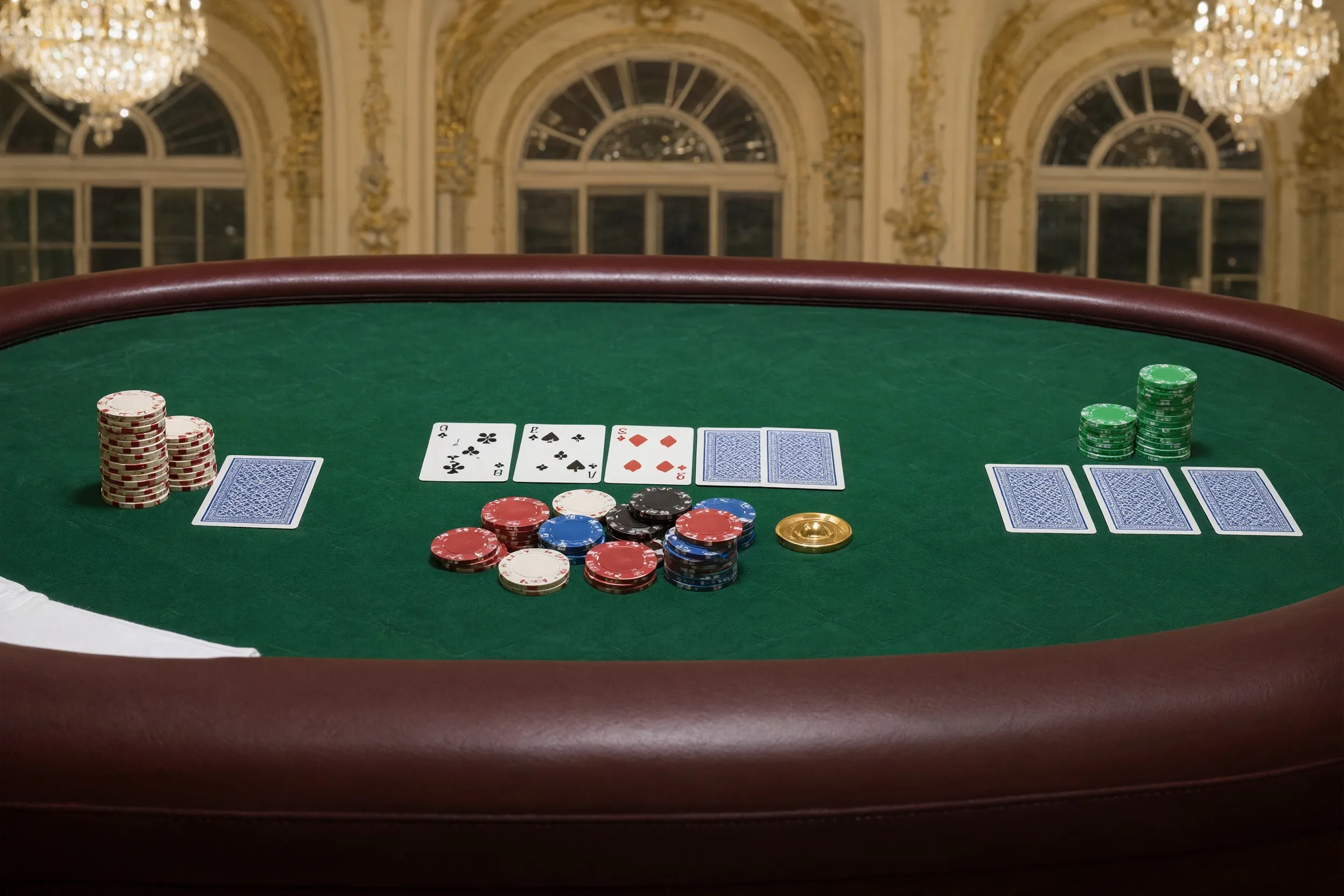
Ask a Hold’em player to try pot-limit Omaha and the first session usually ends in confusion, frustration and a lost buy-in. The two games look nearly identical — same community cards, same betting streets, same hand rankings — yet they play like completely different sports. Omaha deals four hole cards instead of two, demands that you use exactly two of them, and turns every hand into a tangled web of draws that reaches showdown far more often than Hold’em players are used to. That difference is not cosmetic; it rewrites starting hand values, pot odds, bluffing economics and the entire texture of the game.
The basic structure of a hand
A PLO hand follows the familiar poker skeleton, with one significant variation at the dealing stage. The sequence of a standard pot-limit Omaha hand runs like this:
- The blinds are posted — the player to the left of the button puts in the small blind, and the next player posts the big blind, exactly as in Hold’em.
- Each player receives four face-down cards — all four belong to that player alone and remain private throughout the hand.
- The pre-flop betting round begins with the player left of the big blind, and action proceeds clockwise until all active players have matched the pot-limit raise.
- The flop brings three community cards, followed by a betting round starting with the first player left of the button.
- The turn adds a fourth community card and another betting round.
- The river completes the board, and after the final betting round the remaining players show down their hands.
- The best five-card hand wins the pot — built from exactly two of your hole cards and exactly three of the community cards.
The betting structure is where Omaha earns its full name. In pot-limit games, the maximum raise equals the size of the current pot, which produces dramatic geometric growth: a standard open may be 3.5 times the big blind, a 3-bet roughly 11 big blinds, a 4-bet around 34, and a 5-bet frequently leaves players pot-committed. Bluffing is expensive by design, and the game rewards players who enter pots with hands that can genuinely connect with the board.
The two-card rule that changes everything
The single rule that trips up Hold’em converts more than any other is also the simplest to state: you must use exactly two hole cards and exactly three board cards to make your final hand. No exceptions, no combinations in between.
This rule destroys intuitions built in Hold’em. A player holding a single ace of spades with three spades on the board does not have a flush — Omaha requires two spades in hand, so the hand has nothing but the bare ace high. The reverse is equally jarring: a player with three aces among their hole cards and an ace on the board has only trips, because only two of the four aces in hand can legally be used. Even experienced players occasionally catch themselves celebrating a phantom flush, which is why the rule deserves obsessive repetition until it becomes reflex.
The two-card rule also explains why Omaha hands look deceptively strong. With four cards, every player holds six possible two-card combinations, which means made hands cluster tightly together. A board of king-queen-jack with no flushes possible will frequently see three or four players all holding two pair or better, and the phrase “the nuts or nothing” has become Omaha shorthand for exactly this reason. Hands that are merely strong in Hold’em — top pair, two pair — are routinely second-best in PLO, where the winning hands average far higher across the board.
How starting hands differ from Hold’em
Hand values in Omaha follow a different hierarchy entirely, and the shifts surprise players who arrive expecting Hold’em logic. The hands that gain and lose the most value are these:
- Pairs gain dramatically in value. A pair in your hand combined with two unconnected cards can make trips or a boat, and pairs that also carry flush potential — like king-king with two hearts and two spades — become premium monsters.
- Wraparound straight draws dominate. Holding four cards spanning a range, like ten-nine-eight-seven, creates a “wrap” that hits an extraordinary number of straight cards; these draws are worth more than most made hands in Hold’em.
- Two-pair holdings lose value relative to draws. Because so many players make strong hands simultaneously, drawing to the nuts is often more valuable than betting a vulnerable pair.
- Single-suited aces are premium, double-suited aces are gold. An ace-king with two suits, each capable of a nut flush, is one of the strongest hands in the game.
- Weak aces and disconnected hands are toxic. Ace-rag-rag-rag with offsuit cards, which looks playable to a Hold’em convert, bleeds money in Omaha where it is dominated by the same top pairs but cannot make a competitive hand.
This reordering means that Omaha players must think in terms of cooperation between their four cards rather than the strength of the best single card. A hand with four cards that all work together — connectivity, suits, a pair — is worth more than a hand with one monster and three blanks, even when the monster alone looks intimidating.
The myth of having more cards
The most persistent misconception about Omaha deserves its own corner, because it costs real money. Players arriving from Hold’em assume that four hole cards simply give them more ways to win — more chances to hit, more combos, more action. In practice, the opposite effect dominates: the four cards are shared constraints, and everyone at the table holds more of them, so the average winning hand rises while individual holdings become less special.
The flip side is that Omaha produces more frequent multi-way pots with heavy action, which newcomers misread as loose or chaotic play. It is neither. The game’s architecture naturally concentrates value in the middle of the distribution, where many players hold comparable equity, and pots grow large exactly because multiple players have genuine hands. What looks like recklessness is often precise: a player reraising with a wraparound draw against two opponents is not insane if the wrap hits roughly a third of the time and the pot is already large.
Position, pot size and the pot-limit cap
Position works differently in PLO than in Hold’em, and the difference flows directly from the pot-limit structure. Because raises are geometric, later-position players can define pot sizes more aggressively; but because made hands cluster so tightly, the price of being out of position with a marginal hand is far more punishing. The discipline that Hold’em teaches — fold more from early position — becomes even more critical in Omaha, where a marginal hand out of position with a geometrical pot is a slow bleed rather than a leak.
Stack depth matters enormously. In deep-stacked PLO, wrap draws with flush potential become worth raising, because the implied odds of stacking somebody are genuine. In shallow-stacked PLO, made hands like two pair and sets regain value, because there is no room to continue barreling on later streets. Professional Omaha players constantly adjust ranges to stack size in ways that Hold’em players rarely need to.
A comparison at a glance
The differences between the two games are easiest to see side by side, since most questions about PLO are answered by asking how each feature of Hold’em translates across. The comparison below covers the features that actually change decision-making:
| Feature | Texas Hold’em | Pot-limit Omaha |
|---|---|---|
| Hole cards dealt | 2 | 4 |
| Cards used for the final hand | 0–2 from hand, any number from board | Exactly 2 from hand, exactly 3 from board |
| Pre-flop raise cap | No limit | Pot-limit raise |
| Typical winning hands | One pair, two pair often suffice | Two pair, trips, straights and flushes routinely |
| Draw strength | Draws are often one-dimensional | Wraps and combined draws dominate |
| Bluffing economics | Cheaper, more fold equity | Expensive, less fold equity |
| Variance per session | Lower | Considerably higher |
| Implied odds importance | Moderate | Central to the game |
Read down the last three rows and the strategic identity of PLO emerges. The game is not simply Hold’em with more cards — it is a discipline where draws, made-hand clusters and geometric pot growth interact to reward nut-oriented play and punish marginal strength. A Hold’em player who imports their bluffing habits unchanged will find fold equity thinner and their bluffs paid off more often by opponents holding second-best but genuinely strong hands.
Nuts, blockers and the Omaha mindset
Advanced Omaha strategy revolves around one question asked relentlessly on every street: “who can have the nuts here?” Because made hands cluster so tightly, holding the second-best hand is not a small mistake but a catastrophic one, and the cost of overplaying top pair or an overpair is far higher than in Hold’em. This is why disciplined PLO players fold hands that would be automatic raises in Texas Hold’em, and why the phrase “the nuts or a good draw to the nuts” governs most pot-sized decisions.
Blockers add a second layer to this thinking. Holding the ace of hearts when the board shows two hearts means nobody else holds the nut flush — and that knowledge is worth real money, both as a reason to raise for value and as a reason to fold when opponents are betting into you. Omaha is a game of counting outs with precision, because with four hole cards the number of possible combinations behind every draw is staggering, and miscounting outs is one of the most expensive habits in the game.
Building your first PLO session
Approaching pot-limit Omaha for the first time calls for patience and structural discipline rather than aggression. The habits that ease the transition include:
- Play tight from early position. Fold hands with gaps between cards, single suits and weak kickers; the geometric pot sizes amplify every marginal decision.
- Favour double-suited, connected hands. Hands like ace-king-queen-jack double-suited or double-paired hands with strong kickers carry equity in many directions.
- Draw to the nuts, and only the nuts. Non-nut draws — low flushes, middle straights, weak wraps — are the single biggest money-losers for new PLO players.
- Watch pot size growth. Pot-limit raises compound quickly; a hand that was comfortable at 8 big blinds can be a disaster at 40.
- Reduce your stake level. Moving down one or two limits from your Hold’em stakes is the standard advice, and experienced players recommend it without exception.
- Review the two-card rule daily. Even strong players occasionally catch themselves misplaying a hand because they forgot exactly two cards must come from their hand.
The psychological adjustment is as important as the strategic one. Omaha deals more variance per session than Hold’em, and players who expect the same steady grind will feel punished by swings that are mathematically normal. Accepting that the game is a drawing-and-nuts contest rather than a bluffing-and-nerve contest is the mindset that turns confusion into comfort.
The bottom line
Pot-limit Omaha rewards players who understand that four cards do not make you stronger — they make everyone at the table stronger. The two-card rule rewrites hand values, the pot-limit structure makes bluffs expensive, and the clustering of made hands turns second-best outcomes into expensive lessons. Players who approach PLO with Hold’em instincts get ground down; those who learn its logic find one of the most strategically rich games in the entire poker family, with deeper decisions per hand and more frequent multi-way confrontations. The transition is a journey worth taking, but only for players willing to leave their Hold’em intuitions at the door.