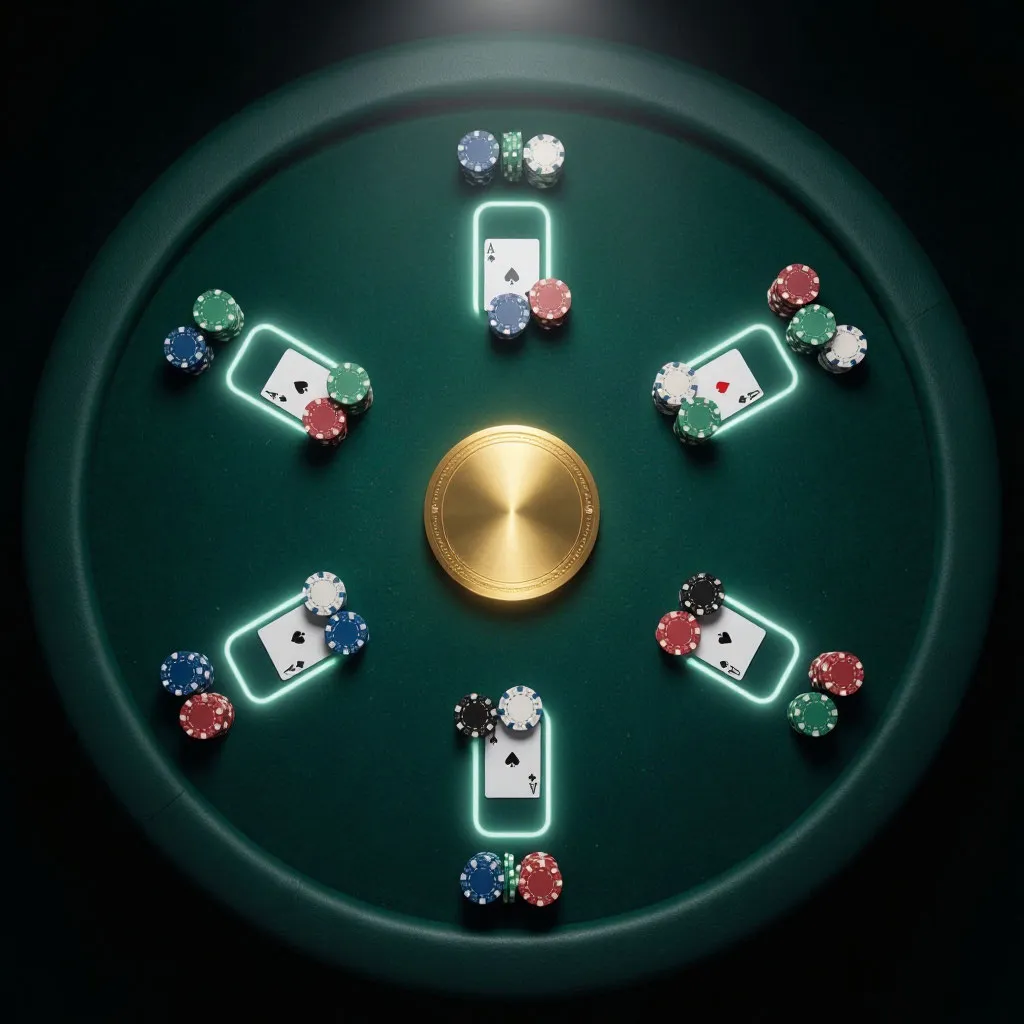
Watch any poker table for ten minutes and one pattern becomes obvious: the same seats keep winning small pots, and the same seats keep folding. That pattern has nothing to do with luck. It comes from where the players are sitting, because position determines who acts first and who acts last — and in a game of incomplete information, acting last is close to a superpower. Anyone who wants to move beyond beginner play needs the vocabulary and logic of seats drilled in early, since almost every hand discussion, training video and strategy chart assumes you already know what UTG, MP, CO, BTN and the blinds mean.
Why position decides so much
Acting after your opponents means seeing what they do before you commit money. If three players check or fold before it is your turn, you get to make a decision with far more information than they had — and the reverse is just as true. The player who acts first is guessing; the player who acts last is reacting. Over thousands of hands, this asymmetry compounds into the single biggest structural edge in poker, bigger than card selection, bigger than aggression, bigger than stack depth for most games.
Position also governs a subtler advantage: pot control. When you act last, you can see a hand end cheaply by checking behind, or inflate it on the rare occasions you hold the goods. When you act first, that same choice belongs to somebody else. This is why the same hand, say king-queen offsuit, can be a raise in one seat and an easy fold in another without any contradiction.
How the table is mapped
A standard nine-handed table divides into zones, and the abbreviations fly around faster than most newcomers expect. Here is the full cast, listed in the order they act after the flop:
- UTG — under the gun, the first seat to speak after the flop, and the hardest place at the table.
- UTG+1 and UTG+2 — the two seats immediately after, still trapped in early position.
- MP — middle position, usually two seats, where the range starts to open up.
- Hijack — the seat two before the button, a modern label for the spot that first gets real stealing opportunities.
- CO — the cutoff, one seat before the button and the second-best chair in the game.
- BTN — the button, the dealer seat, which acts last after the flop and enjoys the cheapest aggression in poker.
- SB — the small blind, forced to pay a half-bet before the cards are even dealt and acting first in every post-flop street.
- BB — the big blind, the full forced bet and the last seat to act pre-flop, which partly compensates for the disaster that follows.
The order is fixed by the dealing position rather than geography: seats are counted backwards from the button, and the two blinds sit immediately to its left. When the table shortens to six or four players, the early and middle zones collapse, leaving roughly three groups — blinds, one or two middle seats, and the button-cutoff pair.
What each zone really costs
Knowing the names is trivial; knowing how much each seat is worth is the useful part. Not all seats are equal in a remote sense — some are catastrophically worse than others, and the gap between the button and UTG is among the largest in the game.
| Seat | Acts after the flop | Range width | Typical challenge | Win-rate reality |
|---|---|---|---|---|
| UTG | First | Tightest, top ~10–15% of hands | Playing blind against eight opponents | Often losing or break-even |
| MP | Third to sixth | Moderate, adds strong broadways | Caught between information poor and stealing rich | Marginal at best |
| Hijack | Seventh | Wide, top ~25% | Still faces cutoff and button behind | Solidly profitable |
| CO | Eighth | Very wide | Only the button remains to act | Clearly profitable |
| BTN | Last | Widest, up to half the deck | Avoiding overconfidence | Most profitable seat |
| SB | First post-flop | Forced half-bet | Out of position against everyone | Consistently losing |
| BB | Second post-flop | Forced full bet | Facing steals with a mediocre hand | Big structural loser |
Two conclusions fall straight out of these comparisons. First, the win-rate gap between the button and the blinds is enormous — the button funds the blinds in a very literal sense, which is why disciplined players are happy to lose the minimum from the blinds and extract the maximum from the button. Second, seat value is relative, not absolute: UTG becomes a mediocre seat in a three-handed game, and the cutoff becomes nearly a second button once aggressive players behind you fold. Full-ring poker punishes bad seats; short-handed poker merely inconveniences them.
The blinds are not just forced bets
The small and big blind deserve their own discussion, because beginners routinely misjudge them. Before the flop they are actually good seats — the big blind acts last pre-flop, sees the action cheap, and can defend with a wide range. The moment the flop lands, everything reverses: the blinds act first on every street for the rest of the hand, out of position against whoever raised. This flip is why blind play is a specialist topic, and why the correct defensive strategy involves calling fewer speculative hands than intuition suggests and three-betting more.
The small blind suffers even more than the big one. It pays half a bet to enter a pot where it will never act last, faces the worst pot odds on the table, and sits directly left of the button — the position of every villain’s strongest seat. The standard remedy is blunt: play very few hands from the small blind, raise instead of call when you do play, and accept that losing less from this seat is itself a win.
Playing from position versus out of it
The practical consequences of seat translate into a few habits that distinguish strong players from the rest:
- Open wider the later your seat. A raisable range from the button can be two or three times larger than from UTG, because fewer players remain to punish the looseness.
- Tighten up before the advantage fades. The hijack and cutoff are where most players overextend; the money leaks here are quiet but constant.
- Value position more than raw hand strength. Two random seats trading mediocre cards favour whoever acts last, every time.
- Attack the blinds relentlessly. Raise frequency from late position should climb as the blinds tighten; free blinds are donated money.
- Fight back from the big blind selectively. Three-bet the players who steal too wide rather than defending passively with everything.
None of these adjustments is complicated to understand, yet all of them require knowing which seat you are in — which is exactly why position first, cards second, remains the oldest and truest hierarchy in poker strategy.
Short-handed and heads-up shifts
Table size reshuffles the whole map. In a six-max game there is no UTG+1 or UTG+2, so ranges loosen across the board and the hijack inherits stealing duties. Heads-up, the absurdity reaches its peak: the button posts the small blind, acts first pre-flop and last after it, meaning the “best” and “worst” seats merge into one player who is simultaneously both. Heads-up ranges are so wide that more than half of all hands become playable from the button, a fact that shocks anyone arriving from full-ring games.
The takeaway
Poker positions are less about memorising labels and more about internalising a single idea: your decision quality depends on how much information you have when you act, and information flows in the direction of the button. Master the seat names early, adjust your ranges to them religiously, and treat the blinds as a tax you minimise rather than a lottery you chase. Every advanced concept in poker — stealing, three-betting, blind defence, positional awareness — is built on this foundation, and it costs nothing to learn except the discipline to fold more from the seats that deserve it.