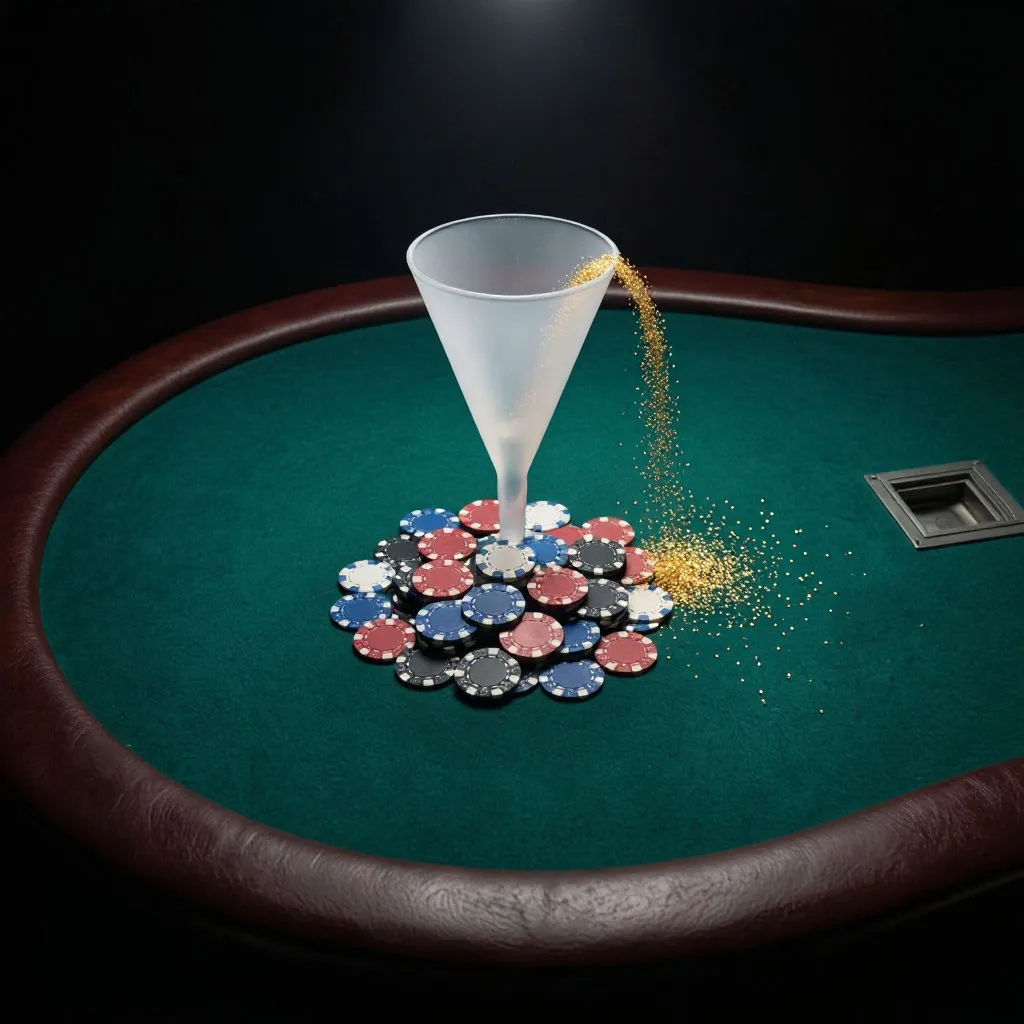
Every pot you win at a poker table has a silent third participant taking a cut before the chips reach you. That cut is the rake — the fee a cardroom or online site charges for hosting the game — and it is simultaneously the most unavoidable expense in poker and the least understood. Most players can name their win rate, their bankroll and their worst bad beat, yet have never once calculated what the rake has actually cost them. For anyone playing regularly, especially at small and mid stakes, understanding rake structures is not bookkeeping trivia: it directly determines whether the game you sit in is even beatable.
What the rake actually is
The rake is the house’s commission on each hand. In a cash game, the dealer or the software automatically removes a percentage of the pot up to a fixed limit, and that money goes to the operator rather than to any player. Live rooms typically take between 5% and 10% of the pot, while online sites cluster around 4.5% to 5.5%. The percentage alone tells you little, though, because two other numbers shape the real cost: the cap, which limits the maximum taken from any single pot, and the threshold, which sets the minimum pot size before any rake is taken at all.
This is where the economics get interesting. A 10% rake with a $3 cap can be far kinder to players than a 5% rake with a $10 cap, because the cap is what most real pots end up hitting. In low-stakes games, where pots are frequently small, the cap is nearly always reached, which means the true rake you pay is effectively the cap itself — a flat tax on every meaningful hand rather than a percentage of your winnings.
How rake is collected in practice
Operators use several collection methods, and the differences between them are anything but cosmetic. The most common structures look like this:
- Percentage with a cap — the dominant model online and in most live rooms; the house takes a slice of every pot past a minimum size, stopping at the cap.
- No flop, no drop — popular in many live rooms; the pot is only raked when a flop is dealt, so hands that end pre-flop cost nothing.
- Time charge or seat fee — common in high-stakes live games, where each player pays a fixed amount every half hour and the pot itself is untouched.
- Jackpot drop — a small extra deduction, often $0.50–$2 per pot, funding bad beat jackpots and promotional prize pools.
- Tournament and sit-and-go equivalents — technically called the entry fee rather than rake, typically 5–10% on top of the buy-in.
The same philosophy extends into the online world through a different channel. Instead of taking rake from pots directly, many modern sites and most poker apps convert it into rakeback or a rewards structure: a share of the rake you generate is returned as cash, points or bonuses. A generous rakeback deal can claw back 20–40% of what you pay, which at high volume becomes the difference between a profitable and a losing player.
A typical structure in numbers
Abstract percentages only click once they are anchored to real stakes, so the clearest way to see what the rake costs is to compare common tables side by side. Figures below reflect widely used industry norms; individual rooms and jurisdictions vary considerably.
| Stakes | Typical rake | Cap per pot | No-flop-no-drop | Cost per 100 hands |
|---|---|---|---|---|
| $1/$2 live | 10% | $10 (higher in some cities) | Often not applied | $15–$25 |
| $2/$5 live | 10% | $10–$12 | Usually not applied | $25–$40 |
| $0.01/$0.02 online | ~5% | $1.00–$1.50 | Standard | $4–$7 |
| $0.25/$0.50 online | ~5% | $3.00 | Standard | $10–$14 |
| $2/$5 online | ~5% | $5.00 | Standard | $20–$30 |
The pattern in the right-hand column explains why small-stakes players feel the squeeze most. Relative to pot sizes, a $1.50 cap at micro stakes eats a far larger share of winning sessions than a $10 cap does at $2/$5 — and even that live cap is a serious toll when average pots hover around $100. Meanwhile, the no-flop-no-drop column shows how the same nominal rake percentage can soften or harden depending on which collection rule accompanies it.
Why rake matters more at low stakes
The brutal arithmetic of low-stakes poker comes down to ratios. If the average pot at a $1/$2 table reaches $80 and the house takes $10, that is 12.5% of the pot — before a single hand of skill has been applied. A mediocre player who would roughly break even in a rake-free game becomes a consistent loser, and a modest winner is pushed close to break-even. Professional and semi-professional players know this instinctively: many refuse low-limit games not because the opposition is tough, but because the tax is proportionally ruinous.
At higher stakes the picture inverts. Since caps are fixed in absolute dollars, a $10 cap on a $5,000 pot is a rounding error, and high-stakes games often switch entirely to time charges so that rake never distorts pot sizes. This is why the effective rake rate falls steadily as stakes rise, and why short-handed online tables at low limits are often described as rake races — the competition is less about outplaying opponents than about paying the house less often than they do.
Measuring what it costs you
Few players ever quantify their own rake burden, yet the calculation is simple enough to do from memory after any session. Start by estimating how many hands per hour you play and what fraction of pots reach the cap, then multiply. An online grinder playing 60 hands an hour in pots that average a $2 rake is paying roughly $120 per hour for the privilege of sitting down — which immediately reframes any win rate smaller than that. Live players face a harsher version of the same exercise, since a $10 cap on most pots across 30 hands an hour can consume $200 or more from the table every hour, spread across whoever wins.
There is also a strategic cost that never appears on any statement. Rake changes the marginal math of close decisions: a thin call that is barely profitable rake-free becomes a clear fold once the house’s slice is subtracted from every pot you contest. Strong players internalise this adjustment automatically, which is one reason experienced regulars seem to fold “too much” to newcomers watching the same odds.
Ways to pay less without playing less
You cannot negotiate with the dealer, but you have more control over rake expense than it first appears. The levers that actually move the number are these:
- Choose your stakes deliberately. Moving up even one level often cuts your effective rake rate significantly, since caps grow slower than pot sizes.
- Shop for rakeback and rewards. Two sites can charge identical rake while returning wildly different shares to the player; loyalty tiers, flat rakeback and VIP schemes deserve as much comparison as welcome bonuses.
- Prefer no-flop-no-drop rooms when playing live. A room that skips the drop on preflop-only hands quietly refunds a meaningful share of your evenings.
- Play shorter-handed. Fewer players per pot means less money raked in total per hour of table time, even though individual hands come faster.
- Avoid formats built on rake. Some jackpot-promoted tables add an extra drop per hand; if you never play for the jackpot, you are subsidising those who do.
- Track it honestly. Most tracking software records rake paid per session, and seeing the number in black and white is the fastest cure for playing games that cannot beat it.
None of these steps changes the game itself, and that is the point. Rake is fixed by the house, so the only intelligent response is to optimise around it — the same discipline applied to any other unavoidable business expense.
The bigger picture
Rake is not a scam; it is the business model that keeps the lights on, pays the dealers and funds the software. But it is also the silent hand constantly dipping into every player’s stack, and the gap between winners and losers at small stakes is often smaller than the gap the rake carves out of everyone equally. Knowing exactly how your room collects, what its caps and thresholds are, and what comes back to you through rewards turns an invisible cost into a managed one — and in poker, where edges are thin, managed expenses are frequently what keeps a winning player winning.