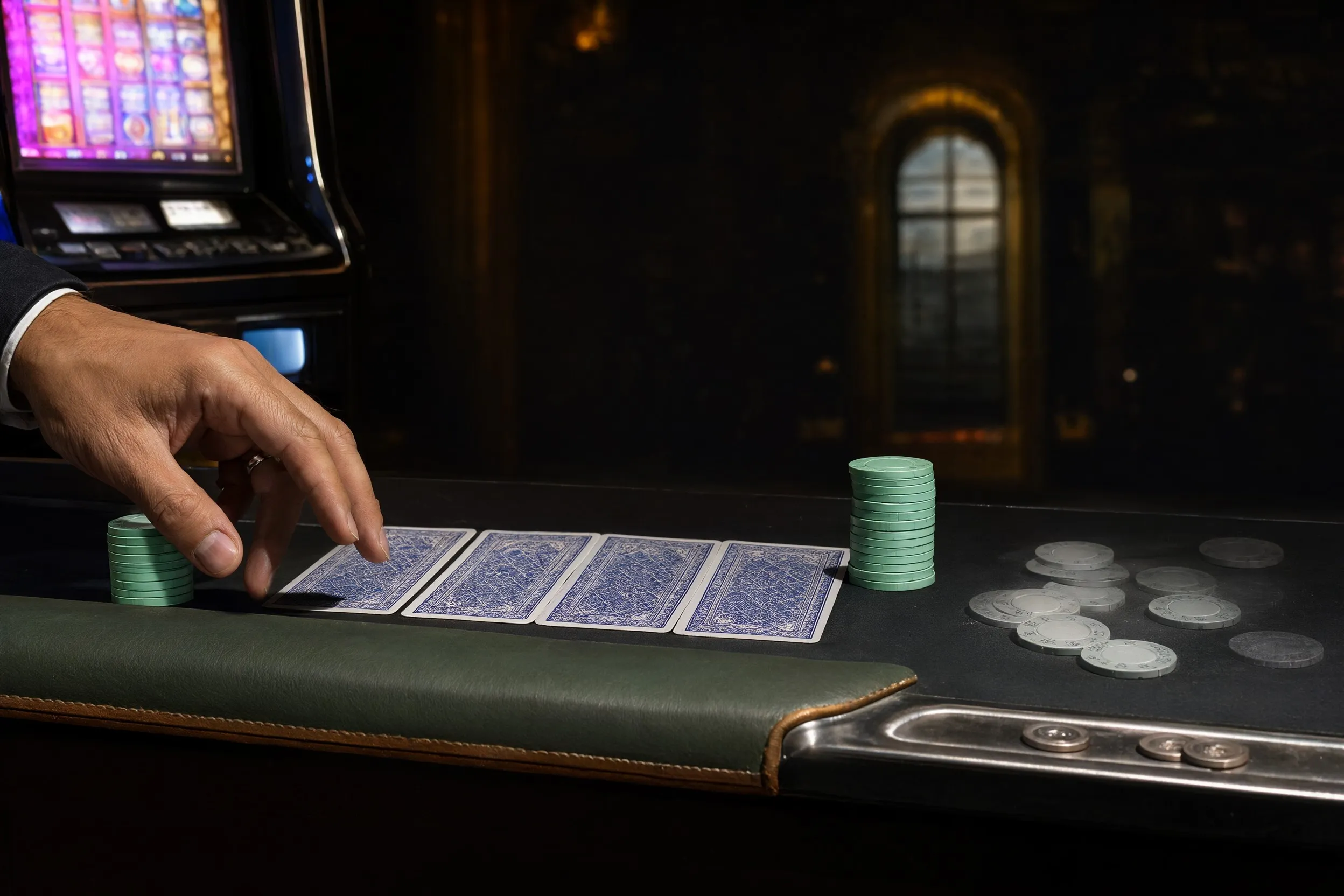
Every slot player knows the moment: the reels stop, a modest win lands on the screen, and the machine offers a choice. Take the money, or press a glowing button marked “gamble” and risk it all on the flip of a card. This is the gamble feature — sometimes called double or nothing, risk game, or take-a-risk — and it is one of the oldest and most misunderstood mechanics in slot design. Played well, it is a legitimate tool for shaping your session; played carelessly, it is the fastest way to hand back everything the reels just gave you.
What the gamble feature actually is
The gamble feature is an optional mini-game offered after a winning spin. Instead of collecting your payout, you may wager it on a roughly even-money proposition — most commonly guessing the colour of a face-down playing card, or whether the next card will be higher or lower. Guess correctly and your win doubles; guess wrong and it vanishes entirely. There is no third outcome, no partial refund, and no way to salvage a wrong guess.
The feature exists because slot mathematics work differently from almost any other casino game. A slot’s advertised RTP of, say, 96% is calculated across all spins, including those where players decline the gamble. When you accept the risk game, you are essentially re-wagering an already-won amount at fresh odds — and how those odds are set determines whether the offer is fair, generous or quietly terrible. This is why two machines that both “feel” the same can treat your money very differently once the gamble button starts blinking.
The main types of risk games
Slot studios have produced a remarkable variety of gamble formats over the decades, and knowing which one you are facing is the first step to playing it intelligently. The most widespread types look like this:
- Red or black — the classic; guess the suit colour of a hidden card for a straight double of your win, sometimes with a series of rounds for quadruple and beyond.
- Higher or lower — a card is shown, and you guess whether the next will be bigger or smaller; odds depend on the visible card, and correct guesses can multiply several times over.
- Ladder or trail — your win climbs a series of steps, and you choose to take a step up or bank the current amount, with the house usually deciding which rung you start on.
- Coin flip — a themed variant of red or black, popular in Asian-market machines, offering a simple fifty-fifty doubling.
- Wheel of fortune — a prize wheel where a segment represents a multiple of your win and the rest represent nothing, common in Braille and inspired cabinets.
Each format asks the same underlying question in a different costume: are you willing to risk a known quantity for the chance of a larger one? The differences lie in how much control the format pretends to give you — and how much it actually does.
The odds behind the offer
Here is the uncomfortable truth that separates informed players from hopeful ones: the gamble feature is rarely neutral, and it is almost never favourable. In most modern slots, the red-or-black format is programmed with the true 50/50 probability, which makes the double-or-nothing proposition fair — neither helping nor hurting your expected value over the long run. But fairness is not the same as wisdom, because doubling at true odds simply moves the variance of your session around without adding a single cent of expected value.
The picture changes with higher or lower and ladder formats, where the house usually builds in a margin. A card showing a nine in higher or lower looks like an easy call, but the game may internally treat the boundary as unfavourable or pay slightly short of true odds. Ladder games are subtler still: the rungs are spaced so that the expected value of climbing is marginally negative, even when each individual step looks achievable. The point is not that studios cheat — they do not — but that the payout tables of these mini-games are set below fair odds more often than players assume.
The comparison below shows how the same $10 win is treated by different gamble formats at their typical settings:
| Format | Typical win chance | Payout on success | Expected value of $10 | House margin |
|---|---|---|---|---|
| Red or black | 50% | $20 | $10.00 | 0% |
| Higher or lower (mid card) | ~55–60% | $18 | ~$10.35 | Slight player edge |
| Higher or lower (edge card) | ~40–45% | $22 | ~$9.50 | Small house edge |
| Ladder, one step | ~50% | $19 | $9.50 | ~5% |
| Wheel, 2x vs bust | ~45% | $20 | $9.00 | ~10% |
Notice how the same nominal “double or nothing” offer can carry anything from a slight player advantage to a 10% margin depending on the format and the visible card. This is why the universal rule for gamble features is to check the paytable first — studios must publish the odds of their risk games, and a player who reads before pressing has already outperformed most of the room.
When gambling a win makes sense
The mathematics alone do not settle the question, because the gamble feature is ultimately about session shape, not expected value. A flat, even-money proposition neither helps nor hurts your bankroll in expectation, which means the decision becomes psychological and tactical rather than purely numerical. The situations where pressing the gamble button earns its keep are these:
- When the win is too small to matter. A payout worth half your base bet is often more useful doubled into a meaningful sum than banked as pocket change.
- When your session is above water and variance is your friend. If you are up on the day and the gamble lets you convert many small wins into a few larger ones, you are consolidating gains rather than grinding them away.
- When the feature is part of your entertainment. Some players genuinely enjoy the card-flip tension; if it is why you are playing, the “cost” is the ticket price for that enjoyment.
- When the odds are genuinely fair. If the paytable confirms a true 50/50 double with no margin, the gamble costs nothing in expectation and is a legitimate lever for volatility.
What never makes sense is the reverse pattern: chasing a big win by gambling it on the thin hope of a jackpot-sized payout. The gamble feature’s ceiling is usually modest — double or quadruple — so the risk is always larger than the reward, and the streaks of doubling that players remember are balanced by the silent stacks of vanished wins that they do not.
Common mistakes that drain bankrolls
The errors players make around this feature are so consistent that they deserve their own catalog. The most damaging habits look like this:
- Gambling every win by default. Treating the double-or-nothing prompt as automatic turns your session into a series of coin flips and multiplies variance without adding value.
- Chasing losses through repeated gambles. After a big loss, the temptation to “win it back” through the gamble feature is intense and mathematically identical to any other chase — the past round is irrelevant to the next.
- Ignoring the odds in the paytable. Not every risk game is fair; assuming so is how 5% and 10% margins survive unchallenged.
- Gambles of large wins. Risking a payout worth 50x or 100x your bet on a coin flip destroys hours of patient grinding in a single second, with no reward commensurate to the risk.
- Believing in patterns. Card colours do not alternate, wheels do not “owe” you, and the shuffle is fresh every time the mini-game starts.
The most insidious of these is the first, because it wears the costume of engagement. Players who gamble every win feel more involved, but they are really converting a game with an RTP of 96% into a game with slightly worse effective returns — and doing so steadily, hand after hand.
The gamble feature in different markets
Regulation shapes this mechanic more than most players realise. In several European jurisdictions, particularly in the United Kingdom and Sweden, gamble features are restricted or banned outright on certain game types, precisely because regulators identified the double-or-nothing loop as a driver of rapid loss. Where the feature is unavailable, slots simply skip the offer and pay wins directly, which changes the texture of the game noticeably — wins feel smaller but arrive with no strings attached.
By contrast, in many markets with lighter oversight, gamble features remain prominent, often with flashy animations and dramatic sound design. The contrast is instructive: the same game in two jurisdictions can offer or withhold the risk game depending purely on local rules, and a travelling player who notices the difference is seeing regulation, not studio preference, at work.
The verdict on the gamble button
The gamble feature is neither a trap nor a gift; it is a lever that trades certainty for variance, and its value depends almost entirely on who is pulling it. Used sparingly, on small wins, in games with fair odds, it is a legitimate way to add spikes to an otherwise flat session. Used compulsively, on large wins, in games with hidden house margins, it is the single fastest method of returning money to the house that the reels have already paid you.
The healthy relationship with this mechanic starts with a simple test: before pressing the gamble button, ask whether you would make this bet with your own money outside the game. If the answer is yes — small amount, fair odds, deliberate choice — the feature is a tool. If the answer is no, or if the finger is already moving before the question is asked, the feature is using you rather than the other way around. In a game category where the house edge is fixed and small, the difference between a controlled session and a wrecked one is rarely the reels; it is the button that glows after them.