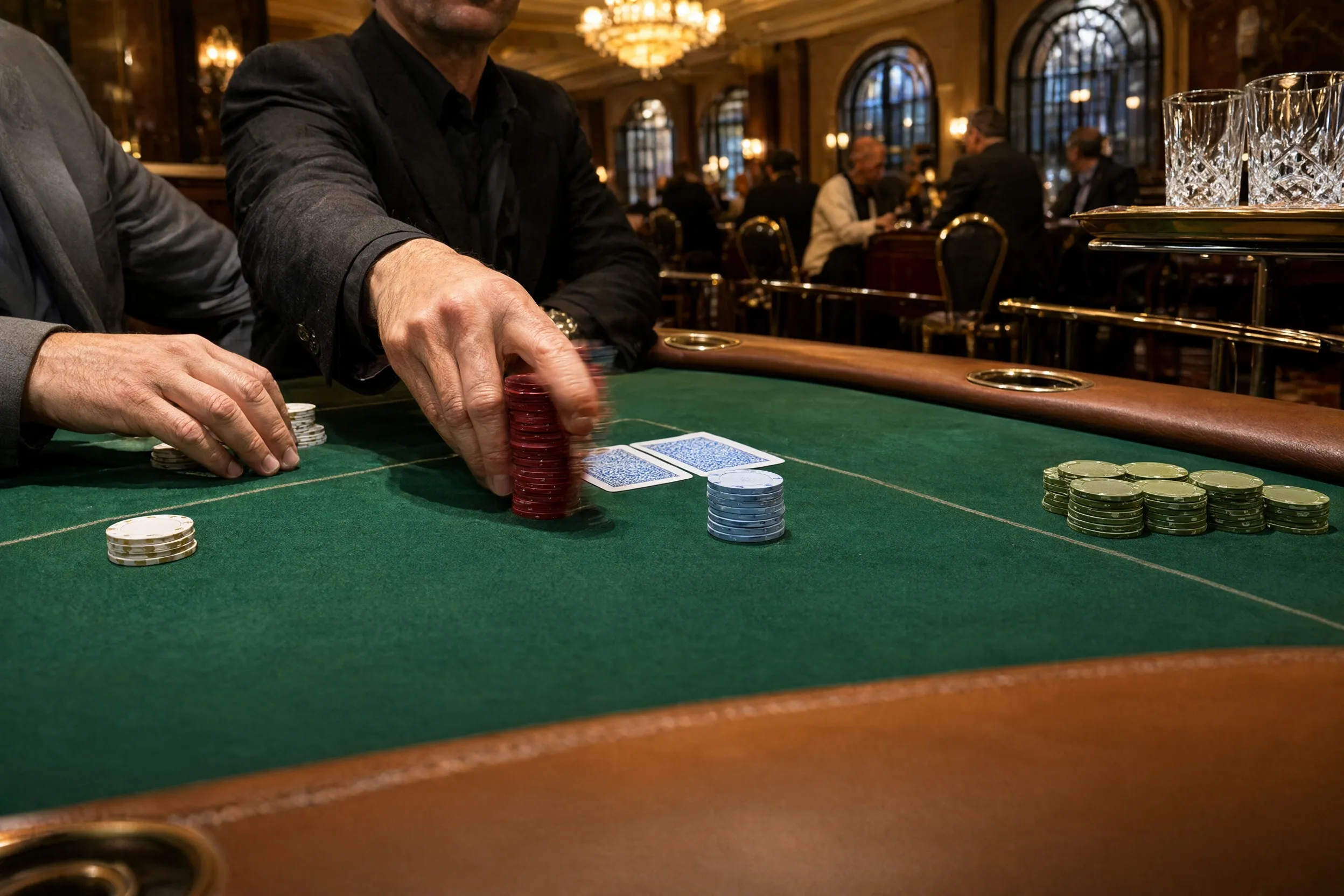
Poker jargon has a way of scaring newcomers with numbers that look wrong at first glance. A 3-bet is the perfect example: it sounds like it should mean three raises in a row, but it actually refers to the second raise in a betting round. The confusion comes from the old limit-poker counting system, where blinds counted as the first bet and the first voluntary raise as the second — so the next raise became the third. Modern no-limit play inherited the label, and today “3-bet” simply means a re-raise before the flop, one of the most consequential actions in the entire game.
The betting ladder in plain terms
Before any strategy makes sense, the vocabulary has to be exact, because players constantly miscount when talking about these actions. The sequence of a pre-flop confrontation runs like this:
- Blinds are posted — these count as bet zero in modern terminology, even though the old system treated them as bet one.
- The first voluntary raise is the 2-bet, better known simply as an open or an open-raise.
- The first re-raise over that open is the 3-bet, the action that defines most pre-flop battles.
- A re-raise over the 3-bet is the 4-bet, and a re-raise over that is the 5-bet, with the pattern continuing until somebody goes all in.
Once you internalise that counting, everything else follows. When a player says they “flatted a 3-bet,” it means they called the re-raise rather than pushing back with a 4-bet. When a coach says a hand is “too weak to 3-bet and too strong to fold,” it refers to that awkward middle zone every player eventually has to map for themselves.
What a 3-bet actually accomplishes
Raising over an open is not one move but several wrapped into one, and skilled players choose their size and frequency based on which job they want done. The main purposes behind a 3-bet are these:
- Value — extracting the maximum from hands like aces, kings and queens that want action from worse aces and strong broadways.
- Isolation — pushing one or more limpers or callers out of the pot so the hand plays against a single opponent with a clearer range.
- Bluffing — taking down the pot immediately with hands that have no showdown value, exploiting opponents who open too wide.
- Pot building — inflating the pot in position with playable hands so that winning it later is worth far more.
The last purpose is the most underestimated. A 3-bet does not have to be a showdown hand or a pure bluff; hands like king-queen suited or small pairs 3-bet profitably in position because the extra money going in pre-flop raises the ceiling of every pot they end up winning. This is why modern ranges from the button include many hands that a beginner would only ever call with.
Sizing the 3-bet correctly
There is no single correct size, but there is a reliable formula players use as a starting point. The standard approach looks like this:
- In position: raise to about three times the original open, plus one big blind for every limper who has already called.
- Out of position: raise to about four times the open, since the extra size compensates for acting first on later streets.
- Against an open from the blinds: size up, often to 3.5–4x or more, because the opener holds position and the 3-bettor needs worse hands to fold before the flop.
- Against multiple callers: add roughly one big blind per additional player who has entered the pot.
These guidelines exist for a reason: undersized 3-bets give the opener cheap odds to continue with a wide range, which defeats the purpose of the isolation and value parts of the raise. Oversized 3-bets, meanwhile, throw away fold equity and turn every bluff into an expensive gamble. The sizes above thread that needle, and most adjustments from there are opponent-specific rather than formula-based.
How ranges differ by position
The math behind 3-betting is easiest to see when it is laid out seat by seat, because frequency changes dramatically as the action moves around the table. Typical winning-player tendencies in six-max cash games look roughly like this:
| Seat | 3-bet frequency | Typical value 3-bet hands | Bluff 3-bet tendencies |
|---|---|---|---|
| UTG | 5–7% | Aces, kings, queens, ace-king | Very few, mostly for balance |
| MP | 7–9% | Strong pairs, big suited aces | Occasional suited broadways |
| Hijack | 9–11% | Adds tens and nines, ace-queen | More flatting of suited connectors |
| Cutoff | 11–14% | Widens further, ace-jack joins | Polarised bluffs appear |
| Button | 14–18% | Nearly all strong hands | frequent suited aces and blockers |
| Small blind | 8–12% | Value-heavy out of position | Mostly blocked-suit bluffs |
| Big blind | 8–13% | Balanced value and defence | Three-bets over wide steals |
Notice the pattern: frequency roughly triples from UTG to the button. That is not aggression for its own sake — it reflects the fact that a 3-bet from the button needs fewer players to fold and enjoys position for the rest of the hand, while a 3-bet from UTG walks into four or five live opponents who can 4-bet or flat with position. Range width and seat advantage move together, always.
Responding to a 3-bet
The other side of the coin matters just as much: when someone 3-bets you, your options are four-bet, call or fold, and each belongs to a specific class of hand. Strong pairs and ace-king want to 4-bet for value, especially against opponents who 3-bet lightly. Medium strength hands that cannot stand a 4-bet but still have equity, like small and medium pairs and strong suited connectors, prefer to call in position and fold out of it. Everything else folds, and this is where discipline pays its bills: the worst leak in low-stakes poker is calling 3-bets with ace-ten type hands and then facing an uncomfortable flop with no plan.
Reading the 3-bettor is half the battle. Some players 3-bet only premiums, which makes folding easy and 4-betting risky. Others 3-bet aggressively as a strategy, which means calling ranges widen and 4-bet bluffs gain value. One useful heuristic: when you hold an ace or a king, you block the top of their value range, which makes them more likely to fold to a 4-bet — a quiet detail that turns average plays into strong ones.
The mistakes that cost the most
Beginners lose a surprising amount of money around 3-bet situations, and the errors repeat with remarkable consistency. The most damaging habits look like this:
- 3-betting premiums and folding everything else. A readable range lets sharp opponents fold every time you raise and attack every time you do not.
- Calling 3-bets out of position. The same marginal hand that is a call on the button is often a fold in the blinds, because you will act first for the rest of the hand.
- Ignoring stack depth. A 3-bet at 200 big blinds plays very differently from one at 40 big blinds, where a 4-bet commits a large share of the stack and forces a decision.
- Revenge 3-betting. Raising over an open simply because the opener folded your blinds twice in a row adds emotion to a decision that needs none.
- Misreading the term in play. Saying “3-bet” when you mean the first raise confuses table talk and makes hand reviews harder than they should be.
Each of these fixes is a matter of habit rather than knowledge, which is both the good news and the hard news: the concepts take an afternoon to learn and months of discipline to execute.
Bringing it together
The 3-bet sits at the crossroads of pre-flop poker — it is where hand selection, position, stack depth and opponent reading all collide into a single decision. Learn the counting so the language stops confusing you, size your re-raises with the formulas above, widen and narrow your range with your seat, and treat the action as a tool with several jobs rather than a single show of strength. Players who master these decisions stop being passengers in big pots and start being the ones setting the price of admission.